Do You Really Need JLPT N2 for Gijinkoku Visa? Full Explanation (No Confusion)
Please support us by sharing!

Over the past few months, there has been a surge of videos and posts online claiming that Japan has introduced a new rule requiring
all Gijinkoku visa holders to have JLPT N2.
This has created confusion and fear, especially among foreign workers already living in Japan or planning to apply.
However, when we carefully read the official immigration announcement, the situation is very different.
In this article, we will break down the rule step by step in a clear and practical way so you can understand:
- What the rule actually says
- When N2 is required
- When it is not required
- How it applies to new applications, renewals, and visa changes
Official Source for This Rule
This rule is not based on assumptions or social media claims. It comes directly from the official Immigration Services Agency of Japan.
You can verify the exact wording of the rule, including the mention of
「対人業務」 and the CEFR B2 requirement, from the official source below:
View official Immigration Services Agency notice (Gijinkoku visa update)
Always refer to official sources like this to understand the rule correctly instead of relying on incomplete or misleading information.
What Changed in 2026 (Official Rule Explained)
Starting from April 15, 2026, Japan introduced additional document requirements for certain work visa applications under the
Engineer / Specialist in Humanities / International Services (Gijinkoku) category.
This update has caused confusion because many people believe it applies to everyone — but that is not correct.
According to the official immigration notice, one key condition was added:
As you can see in the official document or the screenshot shown below, the keyword 「対人業務」 is clearly written.
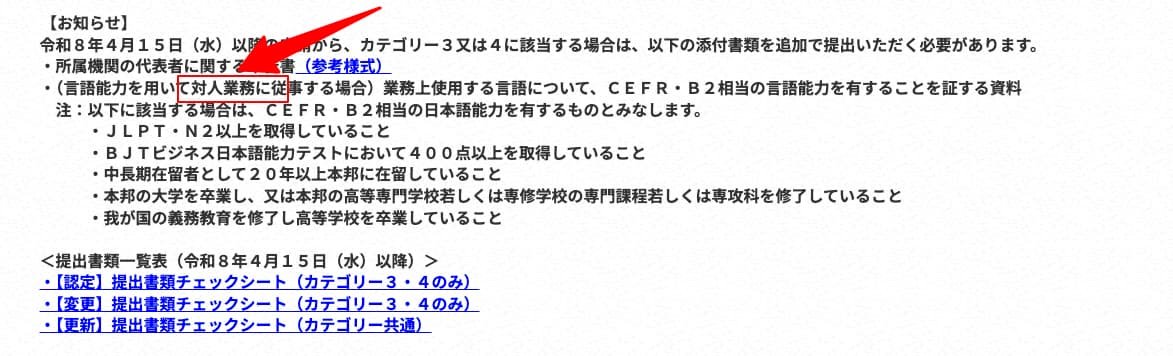
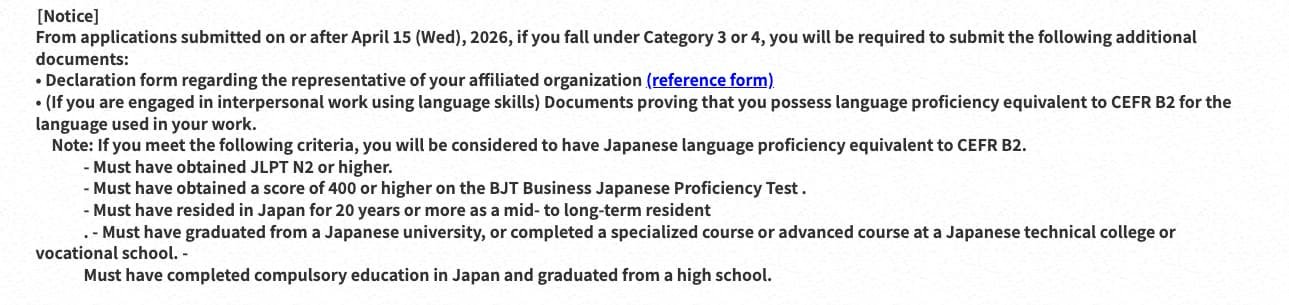
This term is very important because it defines when this rule applies.
It shows that the requirement depends on your actual job duties, not just your visa type.
The rule does NOT mean:
“All Gijinkoku visa holders must have JLPT N2”
Instead, it means:
Only people whose jobs involve communication using language may need to show proof of language ability.
The most important takeaway is that this requirement is conditional.
It depends on your job role and daily work, not automatically on your visa.
Before assuming you need JLPT N2, you should first check whether your job actually falls under
対人業務 (communication-based work).
This Rule Applies to All Visa Situations — But With Conditions
Many people think this rule only applies to new applicants, but that is not correct.
The rule can apply in all of the following cases:
- New visa applications (Certificate of Eligibility)
- Visa renewals
- Changing visa status (e.g., student to work visa)
However, in every case, the condition remains the same:
???? It only applies if your job involves communication-based work.
This means the visa process itself is not the deciding factor — your actual job role is.
What Does “Communication-Based Work「対人業務」” Really Mean?
The term used in the rule is “対人業務,” which translates to work that involves interaction with people using language.
This does not mean occasional meetings or basic workplace communication.
It refers to roles where language is a core requirement to perform the job.
Examples include:
- Sales and marketing roles that require negotiation in Japanese
- Customer support handling clients directly
- Consulting roles requiring discussions and presentations
- Teaching, translation, or interpretation jobs
In these roles, without strong language ability, the job cannot be performed effectively.
Who Does NOT Need JLPT N2
Now comes the most important part — and also the most misunderstood.
The new rule does not apply to everyone. It mainly depends on whether your job actually requires language as a core part of your work.
If your job is technical, operational, or task-based and does not rely heavily on communication, then this requirement usually does not apply to you.
Examples of jobs where N2 is generally NOT required:
- Software developers / programmers
- Backend / frontend engineers
- Infrastructure / network engineers
- System engineers / system maintenance roles
- Technical operators or machinery-related roles (within visa scope)
- Data analysts / database engineers
- Designers working mainly on tools/software (not client-facing)
In these types of roles:
- Your main work is based on technical skills, tools, or systems
- Communication may happen, but it is not the core requirement of the job
The key idea is simple:
If you can perform your job mainly through technical ability rather than language ability, then it is usually not considered
対人業務 (communication-based work).
Because of this, immigration generally does not require high-level Japanese proof like JLPT N2 for these roles.
However, always remember:
Even in technical jobs, if your role becomes client-facing, meeting-heavy, or communication-driven, the requirement may change.
Important: N2 is NOT the Only Way to Qualify
Another major misunderstanding is that the rule requires JLPT N2 specifically.
In reality, the rule only requires proof of CEFR B2 level ability.
This can be demonstrated in multiple ways:
- JLPT N2 or higher
- BJT (Business Japanese Test)
- Graduating from a Japanese university or graduate school
- Living in Japan as a mid-to-long term resident for over 20 years
This is especially important for people who studied in Japan.
If you completed your education in Japan, you may already meet the requirement without needing N2.
What About Applicants from Outside Japan?
For people applying from outside Japan, the same logic applies.
Immigration does not treat them differently based on location.
Instead, the focus is on:
- The type of job
- The actual duties
For example:
- Programming or engineering roles → usually no N2 required
- Customer-facing roles → may require language proof
Why Social Media Is Causing Confusion
Many online videos simplify complex immigration rules into short statements.
A common example is:
“Japan now requires N2 for all foreign workers.”
This is misleading because:
- It ignores the conditional nature of the rule
- It does not consider job type
- It focuses only on one part of the announcement
As a result, people get unnecessary stress and confusion.
How to Know If YOU Need N2 or Not
The most reliable way to understand whether this rule applies to you is not by watching random videos, but by checking your own situation carefully.
Every case is different. The requirement depends on your actual work, not just your visa type.
You should first consider:
- Your job title
- Your daily tasks and responsibilities
- How much Japanese communication your work actually requires
If you want to verify the rule directly, you can check the official Immigration Services Agency notice below:
View official Gijinkoku visa update (Immigration Services Agency)
This is the best source to confirm the exact wording, including the condition related to
「対人業務」.
In addition, a practical way to understand your personal case is to use an AI tool or chatbot.
Simply copy the rule (or the content from this article), paste it into the tool, and describe your situation.
For example:
This approach gives you a more accurate and personalized answer based on your real job situation.
Instead of relying on general or viral information, always base your decision on:
official sources + your actual job details.
Final Conclusion
The 2026 rule does not introduce a universal N2 requirement.
Instead, it introduces a more logical system:
- Language proof is required only for communication-heavy roles
- Technical roles are generally not affected
- Multiple ways exist to prove language ability
If you are working in IT, system development, or other technical fields, this rule will likely not impact you directly.
The key is to understand your job role clearly and rely on official information rather than viral content.