Japan Work Visa New Rules 2026: What Changed for Gijinkoku Visa?
Please support us by sharing!

If you are planning to work in Japan or already holding a work visa, you may have noticed something recently — getting approval is becoming harder.
Japan has started tightening its immigration system, especially for the Engineer / Specialist in Humanities / International Services (Gijinkoku) visa. Many applicants are now facing rejections even with similar profiles that worked before.
In this guide, we will clearly explain the latest immigration rule changes in 2025–2026 and what they actually mean for you.
Stricter Screening for Gijinkoku Visa
One of the biggest changes is how immigration now reviews applications.
Full Profile Check Instead of Document Check
Earlier, having correct documents was often enough. Now, immigration checks:- Your actual job duties
- Your education and work experience
- Whether your job truly matches your visa category
Renewal Is Also Strict Now
Even visa renewals are no longer simple. Immigration re-evaluates your entire situation again, not just extending your stay.Official reference:
https://www.mofa.go.jp/j_info/visit/visa/
Company Background Matters More Than Before
Another major shift is the focus on the company.
Company Compliance Is Checked
Immigration now checks:- Company financial condition
- Business legitimacy
- Past record with foreign workers
Bad Companies Affect Your Visa
If a company has:- Labor violations
- Fake job roles
- Unpaid wages
Visa Fee Increase in Japan: What’s Changing?
Another important change being discussed in Japan’s immigration system is the increase in visa-related fees.
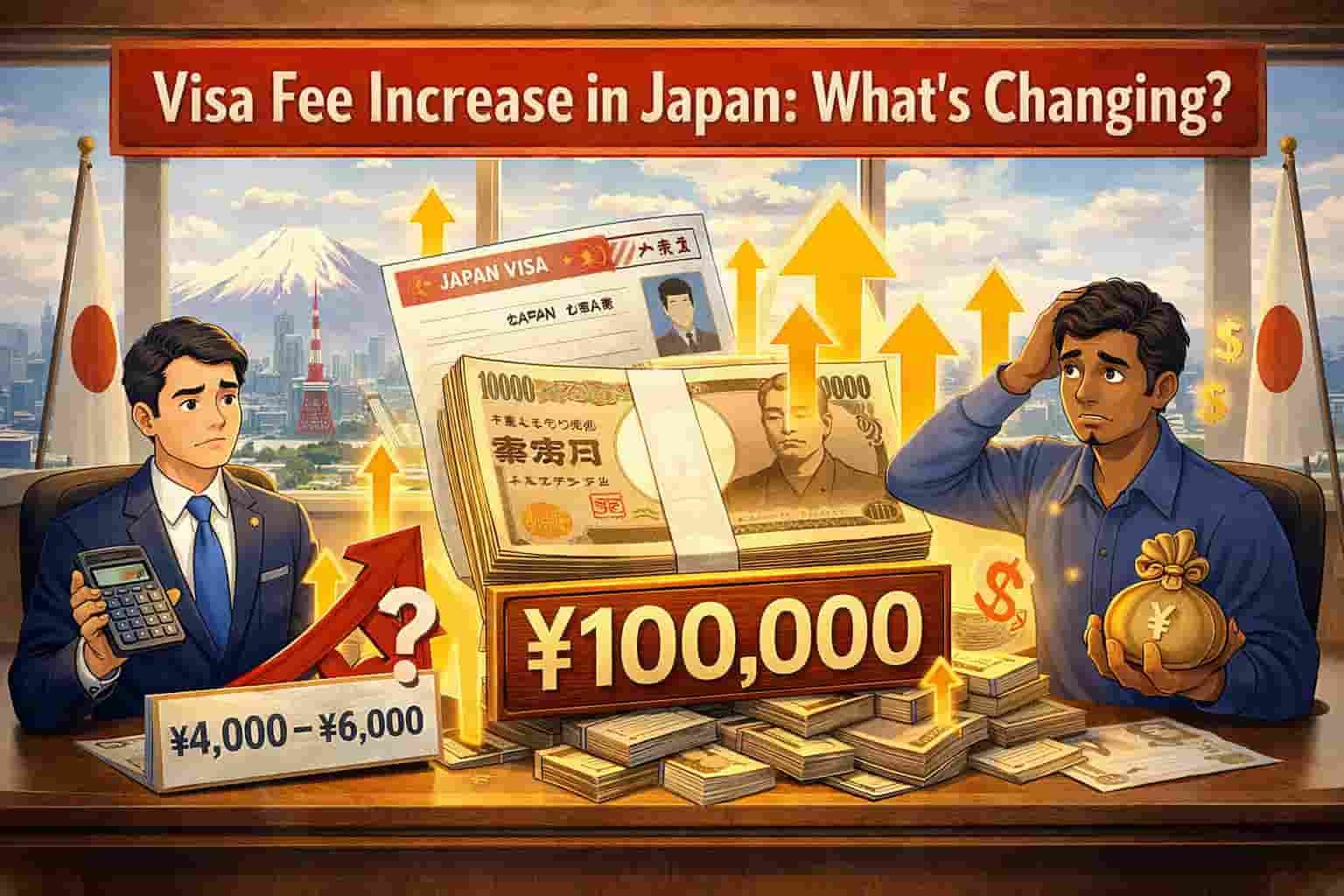
Currently, most work visa procedures—such as status change or renewal—cost only around ¥4,000 to ¥6,000, which is relatively low compared to many other countries.
However, this may not stay the same in the future.
Proposed Fee Increase Up to ¥100,000
The Japanese government has introduced a policy direction that allows visa-related fees to be increased significantly.Under this proposal, the maximum fee could go up to ¥100,000 (1 lakh yen).
It is important to understand that this is a maximum limit, not the current fee.
Current Status: Not Implemented Yet
As of now:- The current visa fees are still around ¥4,000–¥6,000
- The new higher fees have not been applied yet
This means applicants are still paying the standard low fees for now.
Expected Timeline
Based on recent policy updates:- Discussion and approval phase: 2025–2026
- Possible implementation: late 2026 or later
There is no officially confirmed date yet for when the new fees will take effect.
Will Fees Jump Directly to ¥100,000?
Most likely, no.In reality, fees are expected to increase gradually. For example:
- First increase to around ¥10,000–¥30,000
- Higher increases may come later depending on policy changes
Why Japan Is Increasing Visa Fees
The main reasons behind this change include:- Rising number of foreign workers and applications
- Higher administrative and processing costs
- Stronger immigration checks and compliance systems
- Digitalization of visa procedures
Official Reference
For official visa information, you can check:https://www.mofa.go.jp/j_info/visit/visa/
https://www.isa.go.jp/en/
In simple terms: visa fees in Japan are currently low, but the government is preparing to increase them in the future. The exact amount and timing are not fixed yet, but changes are expected in the coming years.
New Pledge Rule (2026 Update)
In 2026, Japan introduced a stricter compliance step for some work visa applications—especially in cases where foreign workers are hired through agencies or sent to client companies.
The main goal of this rule is simple:
to stop misuse of work visas where job roles on paper do not match actual work.
What Is the Pledge Requirement?
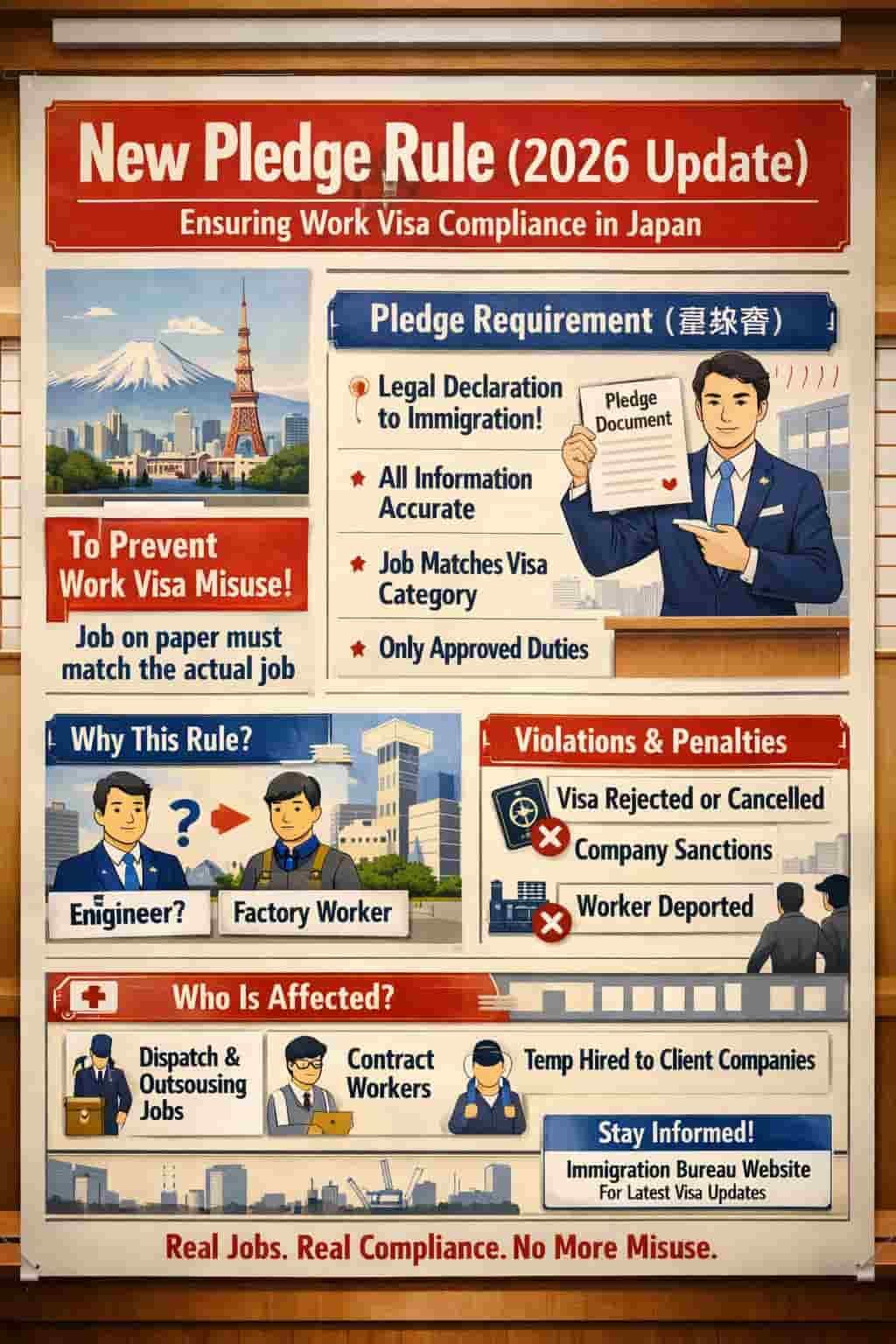
In certain cases (mainly dispatch or outsourcing jobs), companies must now submit a formal written declaration (誓約書).This is not just a simple document—it is a legal promise to immigration authorities.
The company must confirm:
- All submitted documents and information are accurate
- The job position is real and matches the visa category
- The employee will perform only the approved work duties
Why This Rule Was Introduced
In recent years, there were many cases where:- People were hired as “engineers” or “office staff”
- But actually worked in simple or unrelated jobs (factory, cleaning, etc.)
To fix this, immigration now requires companies to take clear responsibility for what they submit.
What Happens If the Rule Is Violated?
Because this is a legal declaration, the consequences are strict:- Visa application or renewal can be rejected
- Existing visa may be cancelled in serious cases
- Companies may face restrictions or lose the ability to sponsor visas
Who Needs to Worry About This?
This rule mainly applies to:- Dispatch (派遣) jobs
- Outsourcing or contract-based work
- Situations where you are hired by one company but work at another location
If you are directly hired and working only for your company (for example, as an in-house web developer), this rule usually does not apply—but your job role must still match your visa.
Official Reference
For official visa rules and updates, you can check:Inquiried about visas application
In simple terms: immigration is no longer checking only your documents—it is making sure your actual job, company, and working conditions are all genuine and consistent.
Stronger Salary and Job Level Checks
In recent years, Japan immigration has started paying much closer attention to salary level and job quality when reviewing work visa applications—especially for the Engineer / Humanities / International Services (Gijinkoku) visa.
This is because salary is used as a key indicator to judge whether your job is genuine, skilled, and stable.
Equal Pay Requirement
One of the most important rules is:Foreign workers must be paid equal to or higher than Japanese employees doing the same job.
Immigration checks:
- Your employment contract salary
- Company salary structure
- Market salary for similar roles
This rule exists to prevent companies from hiring foreigners at lower wages unfairly.
According to immigration guidelines, if your salary is clearly lower than Japanese workers in the same position, your application can be rejected.
No Fixed Minimum — But Practical Range Exists
Japan does not officially publish a fixed minimum salary for this visa.However, in practice:
- ¥200,000 – ¥250,000/month is often considered a basic acceptable range
- Below this level may trigger strict review
Immigration mainly checks whether your income is enough for a stable life and matches industry standards.
Low Salary = High Risk
A low salary is one of the biggest red flags for immigration.If your salary is too low:
- Your job may be considered “unskilled” or not suitable for this visa
- Your application may go under deeper investigation
- Your visa can be rejected or renewal denied
For example, if a foreign engineer earns significantly less than Japanese engineers in the same company, immigration may consider it inappropriate and refuse the visa.
Salary Also Reflects Job Skill Level
Immigration does not look at salary alone—they use it to understand your job level.In simple terms:
- High-skilled job → higher salary → safer approval
- Low salary → may indicate simple or non-skilled work → higher rejection risk
This is important because this visa is only for professional and specialized work, not manual or basic labor.
Important Note for Applicants
Even if your documents are correct, your visa can still be rejected if:- Your salary is too low for your job role
- Your job title says “engineer” but salary looks like part-time or low-skill work
Immigration now checks consistency between:
job title + job duties + salary level
In simple terms: your salary must prove that your job is real, skilled, and fairly paid—not just written on paper.
More Control on Dispatch and Contract Jobs
Actual Work Is Being Verified
Immigration now checks:- Where you actually work
- What tasks you perform daily
Misuse of Engineer Visa Is Targeted
Many people were hired as engineers but worked in simple jobs. This is now a major reason for rejection.Digitalization and System Changes
Online Immigration Process
Japan is moving toward digital systems for visa applications and tracking.Faster but Stricter
While processing may become faster, verification is becoming more detailed and data-driven.What These Changes Mean for You
These new rules don’t mean Japan is stopping foreign workers.
Instead, it means:
- Only genuine applicants are approved
- Fake or unclear jobs are rejected
- Companies are held responsible
High Risk Cases
You are at higher risk if:- Your job doesn’t match your degree
- Your company is unstable
- Your salary is low
- You are in unclear contract roles
Conclusion
Japan’s immigration system is becoming more strict, but also more transparent.
The biggest change is simple:
It’s no longer just about documents — it’s about your full profile, your job, and your company.
If you understand these new rules and prepare properly, getting a work visa is still very possible.