How to Remember Kanji You Keep Forgetting
Please support us by sharing!

You learn a Kanji, understand it, and feel sure you will remember it. Then a few days later you see the same character and your mind goes blank.
That is one of the most frustrating parts of learning Kanji.
Sometimes you forget the meaning. Sometimes the reading disappears. Other times you keep mixing one character with another that looks almost the same.
The solution is not always to restart the whole JLPT list. A better approach is to find the Kanji that repeatedly cause problems and give those characters more focused revision.
That is also why we added features such as Custom Study Lists, Personal Notes and Learning status to our Learn Kanji app. They give you a simple way to keep troublesome Kanji together instead of losing them inside a much larger list.
First, Find Out What You Keep Forgetting
Before repeating a difficult Kanji again, try to understand exactly what is causing the problem.
- Shape: You cannot remember how the character looks.
- Meaning: You recognize it but cannot remember what it means.
- Reading: The meaning is familiar, but the reading disappears.
- Vocabulary: You know the Kanji alone but struggle when it appears inside a word.
- Similar characters: You keep confusing it with another Kanji.
This small check matters because different problems need different kinds of revision.
If the reading is difficult, review vocabulary that contains the Kanji. If the shape is the problem, writing or comparing its components may help more. If two characters look similar, study them together instead of separately.
A Simple Rule
When the same Kanji keeps giving you trouble, stop treating it like every other character. Put it into a focused revision group and return to it more often until it becomes easier to recognize.
Create Your Own “Difficult Kanji” List
Suppose you are studying N3 and most characters are going well, but 12 Kanji keep causing problems.
You should not need to search through the full N3 list every time just to find those same 12 characters.
In our Learn Kanji app, you can create your own Custom Study Lists. One useful idea is to create a list called Difficult Kanji and add characters whenever you notice that they need extra revision.
You can also create other lists depending on how you study:
- Kanji I Keep Forgetting
- N3 Exam Review
- Similar Kanji
- This Week's Revision
- Kanji from Work
When you later have ten minutes to study, you can open that smaller list and work directly on the Kanji that actually need your attention.

Do Not Add Every Kanji to the List
A Difficult Kanji list is useful because it is smaller than your normal study material.
If you add every character, it eventually becomes another large JLPT list.
Add a Kanji when there is a real reason:
- You forgot it several times.
- You keep choosing the wrong reading.
- You confuse it with another character.
- You cannot recognize it inside vocabulary.
- You regularly forget part of its shape.
As a Kanji becomes more familiar, you can focus your attention on the next character that still needs work.
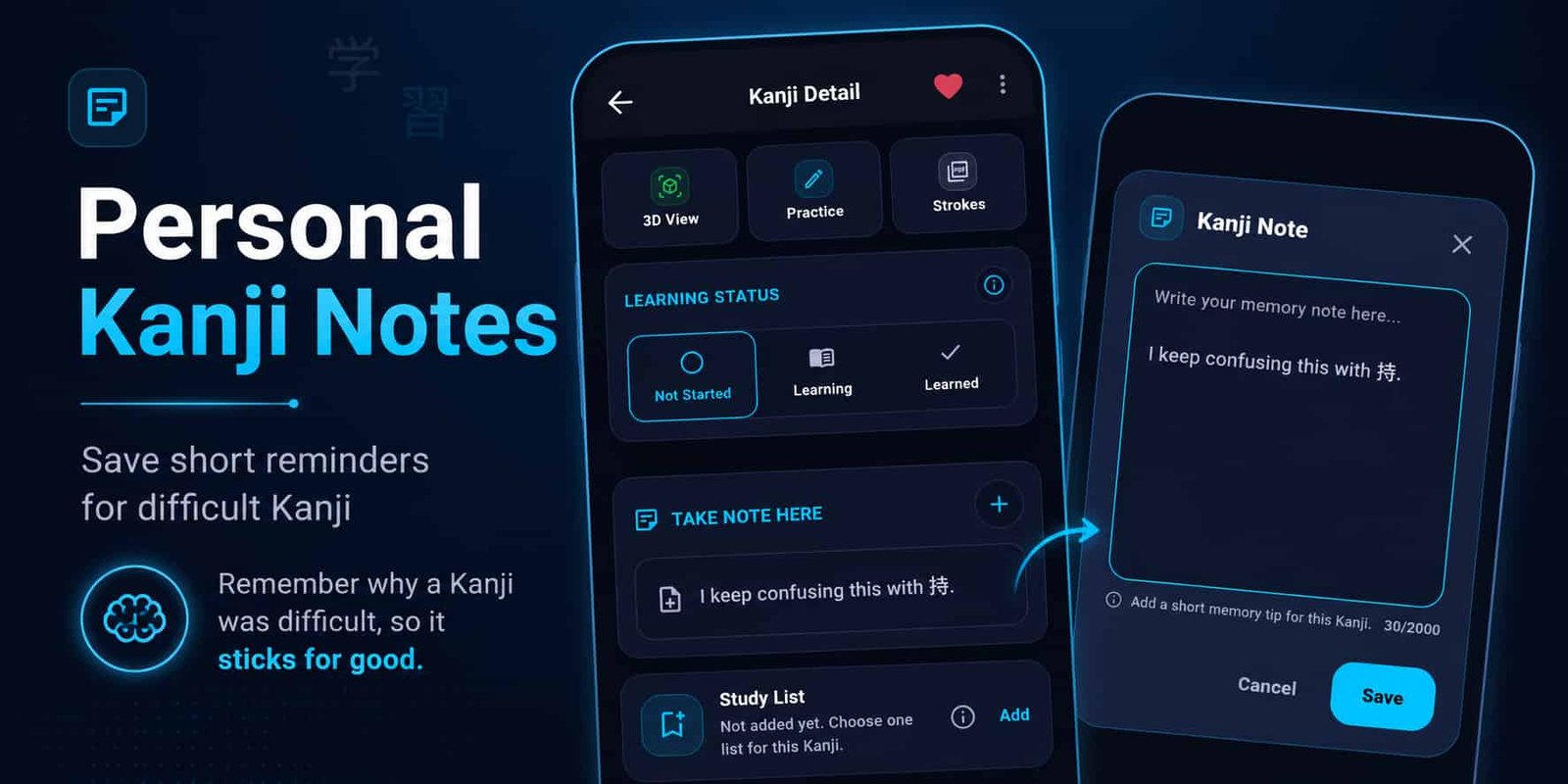
Save a Personal Note About the Problem
When you return to a difficult Kanji several days later, you may remember that it was difficult but forget exactly why.
This is where a short personal note can help.
We added a Personal Note feature to our Learn Kanji app so you can leave your own reminder on an individual Kanji.
Your note does not need to be long. In fact, short notes are often more useful:
- “I keep confusing this with 持.”
- “Review the kunyomi again.”
- “The right side is what I keep forgetting.”
- “Remember this through 経験(けいけん).”
- “I saw this Kanji on a station sign.”
Next time you open that character in our app, your own note is there to remind you what deserves extra attention.
Try to Remember Before You Open the Answer
When you open your Difficult Kanji list, give yourself a few seconds before checking the details.
Look at the character and try to remember its meaning or reading first.
If you remember it, good. If you cannot, open the Kanji detail page and check what you missed.
This is more useful than immediately reading the answer every time because it shows you which characters are becoming easier to recall and which ones still need more work.
Remember Kanji Through Real Words
An isolated Kanji can be difficult to hold in memory. A useful word gives it more context.
For example, instead of remembering only 験, you can connect it with 経験(けいけん), meaning “experience.”
When you open a Kanji in our Learn Kanji app, use its readings and available vocabulary to choose one or two words that you personally want to remember.
This can make the character feel less like a random symbol and more like part of real Japanese.
Compare Similar-Looking Kanji Together
Some characters are difficult because your brain keeps replacing them with another similar-looking Kanji.
For example, 待 and 持 can be confusing at first. The same can happen with 未 and 末.
Instead of reviewing them on different days, put them next to each other and look specifically at what changes.
You could also create a Similar Kanji Custom Study List in our app and keep these confusing pairs together for later revision.
Write the Kanji When the Shape Keeps Disappearing
If the meaning and reading are fine but you cannot reproduce the character yourself, writing can help you notice which part you are forgetting.
Look at the Kanji, hide it, and try to write it from memory. Then compare your version with the original.
Our Learn Kanji app also includes writing practice, so you can open the character and practise it directly when the shape needs more attention.

Keep It Marked as Learning Until You Are Ready
You do not need to mark a Kanji as Learned just because you studied it once.
In our Learn Kanji app, you can keep difficult characters marked as Learning while they still need active revision.
Once you can recognize the character more comfortably and remember its important readings or meanings, you can move it to Learned.
Using Learning status together with a Difficult Kanji list gives you a simple system: your Learning list shows what you are currently studying, while your Difficult Kanji list highlights the smaller group that needs extra attention.
A Simple Revision Routine
- Open your Difficult Kanji list.
- Look at each Kanji before opening its details.
- Try to remember the meaning and reading.
- Check one useful vocabulary example.
- Read your personal note if you saved one.
- Practise writing when the shape is the problem.
- Keep reviewing the character until it becomes easier.
This does not need to take a long time.
A short session focused on the Kanji you actually forget can be more useful than repeatedly reviewing characters you already recognize without difficulty.
Build Your Own Difficult Kanji Revision List
Our Learn Kanji app lets you create personal study lists, save notes and keep the characters you are still learning organized in one place.
Download Our Learn Kanji AppFinal Thoughts
Forgetting Kanji is frustrating, but it does not mean you need to restart from the beginning.
Find the characters you repeatedly struggle with and treat them differently from the ones you already know. Keep them together, connect them with useful words, compare similar characters and leave yourself a small note about what you tend to forget.
We built Custom Study Lists, Personal Notes and Learning status into our Learn Kanji app to make this kind of personal revision easier.
The goal is simple: over time, your Difficult Kanji list should become smaller as more of those characters finally start to stick.