Why Does Japanese Have So Many Kanji?
Please support us by sharing!
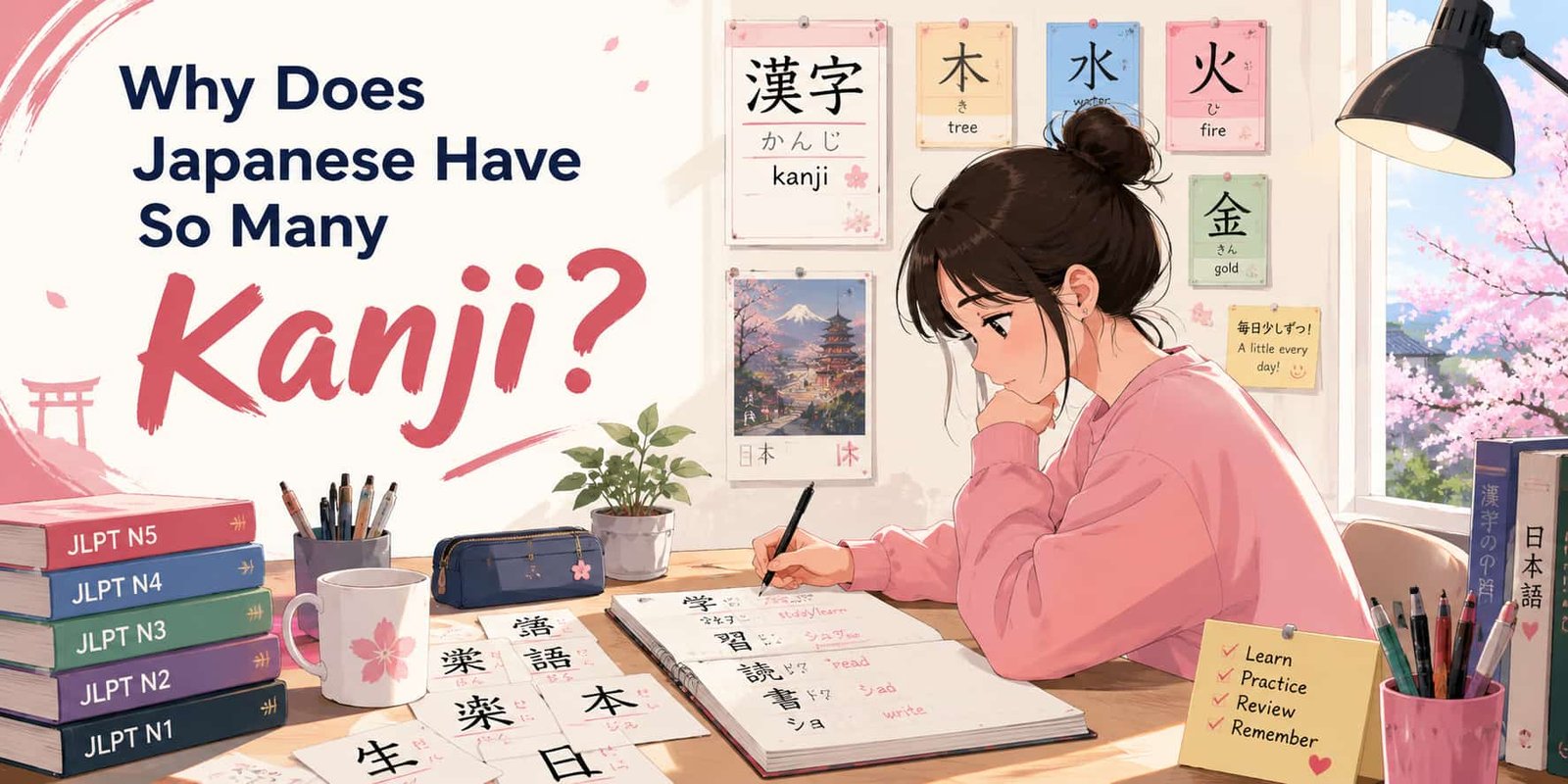
If you have just started learning Japanese, there is a good chance you have already had this thought: “Why are there so many Kanji?”
At first, Japanese can feel quite friendly. You learn あいうえお, get comfortable with Hiragana, learn Katakana, and then you start seeing characters like 日, 本, 学 and 語 everywhere.
Then things get interesting. One Kanji can have different readings, several Kanji can sound the same, and some characters seem incredibly complicated.
So why did Japanese end up with such a large collection of characters? The answer becomes much easier to understand when you look at how the Japanese writing system developed.
Want to Start Learning Kanji?
Learn Kanji: JLPT N5–N1 gives you one place to study Kanji, practise writing, review vocabulary and test yourself.
Get Learn Kanji on Google PlaySo, Why Does Japanese Use Kanji?
The short answer is history. Japanese already existed as a spoken language, but Japan did not originally have the writing system we know today.
Chinese characters were introduced to Japan through historical contact with China and Korea. Over time, Japanese writers began using these characters to represent Japanese words and meanings. This process was not simple because Chinese and Japanese are very different languages.
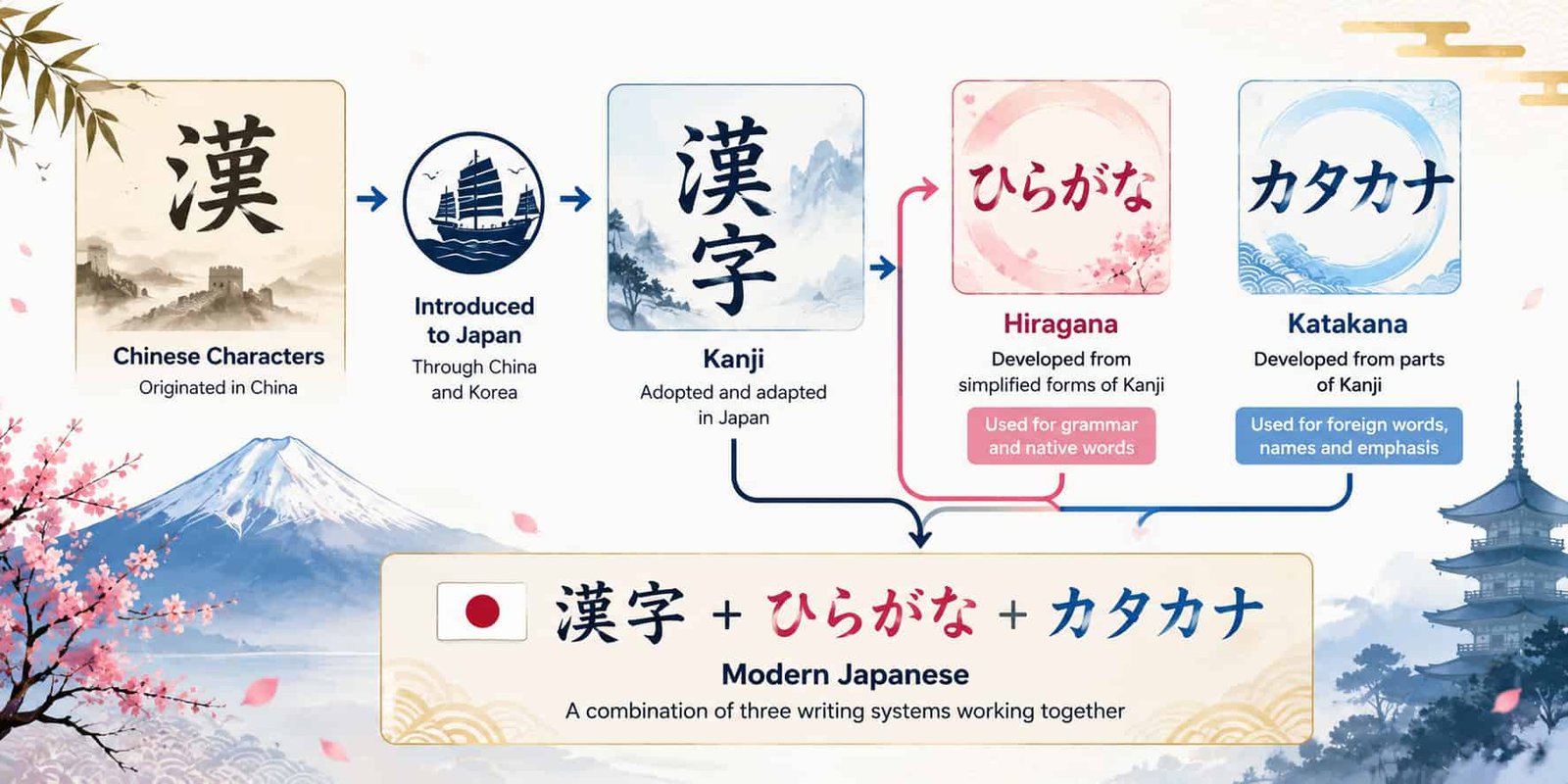
Japanese eventually developed its own way of using Kanji. Hiragana and Katakana also developed from historical forms of Chinese characters.
That is why modern Japanese is not simply “Chinese characters.” It is a combination of different writing systems that work together.
Kanji, Hiragana and Katakana: What Is the Difference?
This is one of the first things that makes Japanese writing look complicated to beginners. But each writing system has a different job.
Kanji
Kanji generally carry meaning and are commonly used for nouns, word roots and important parts of sentences.
Hiragana
Hiragana is widely used for grammar, particles, verb endings and many native Japanese words.
Katakana
Katakana is commonly used for foreign words, foreign names and some types of emphasis.
Look at a simple sentence such as:
私は日本語を勉強します。
You can see all three systems working together. Kanji carries much of the meaning, while Hiragana handles grammatical parts of the sentence.
Once you start recognizing this pattern, Japanese sentences become much less intimidating.
Why Not Just Write Everything in Hiragana?
This is a very reasonable question.
After all, Hiragana can represent Japanese sounds. So why bother learning hundreds or thousands of Kanji?
The biggest reason is readability.
Kanji gives your eyes a quick clue about what a word means. When you are reading a longer Japanese sentence, those visual differences can make it much easier to understand where one word ends and another begins.
Kanji can also help separate words that have the same pronunciation.
For example, はし can refer to different words depending on the Kanji and context. You may encounter 橋 for “bridge” and 箸 for “chopsticks.”
When you see the Kanji, the meaning becomes much easier to identify.
Why Are There So Many Different Kanji?
Japanese uses Kanji for many different words and concepts, so naturally the number of characters is large.
But there is another important point: you do not need to learn every Kanji at once.
If you are studying Japanese for the JLPT, the levels give you a much more manageable way to organize your learning.
Instead of looking at thousands of characters and thinking, “I have to memorize all of these,” you can start with N5 and gradually work upward.
Think About Kanji in Levels
One Kanji Can Have More Than One Reading
This is probably the part that surprises Japanese learners the most.
You might learn one Kanji and then discover that it is pronounced differently in another word.
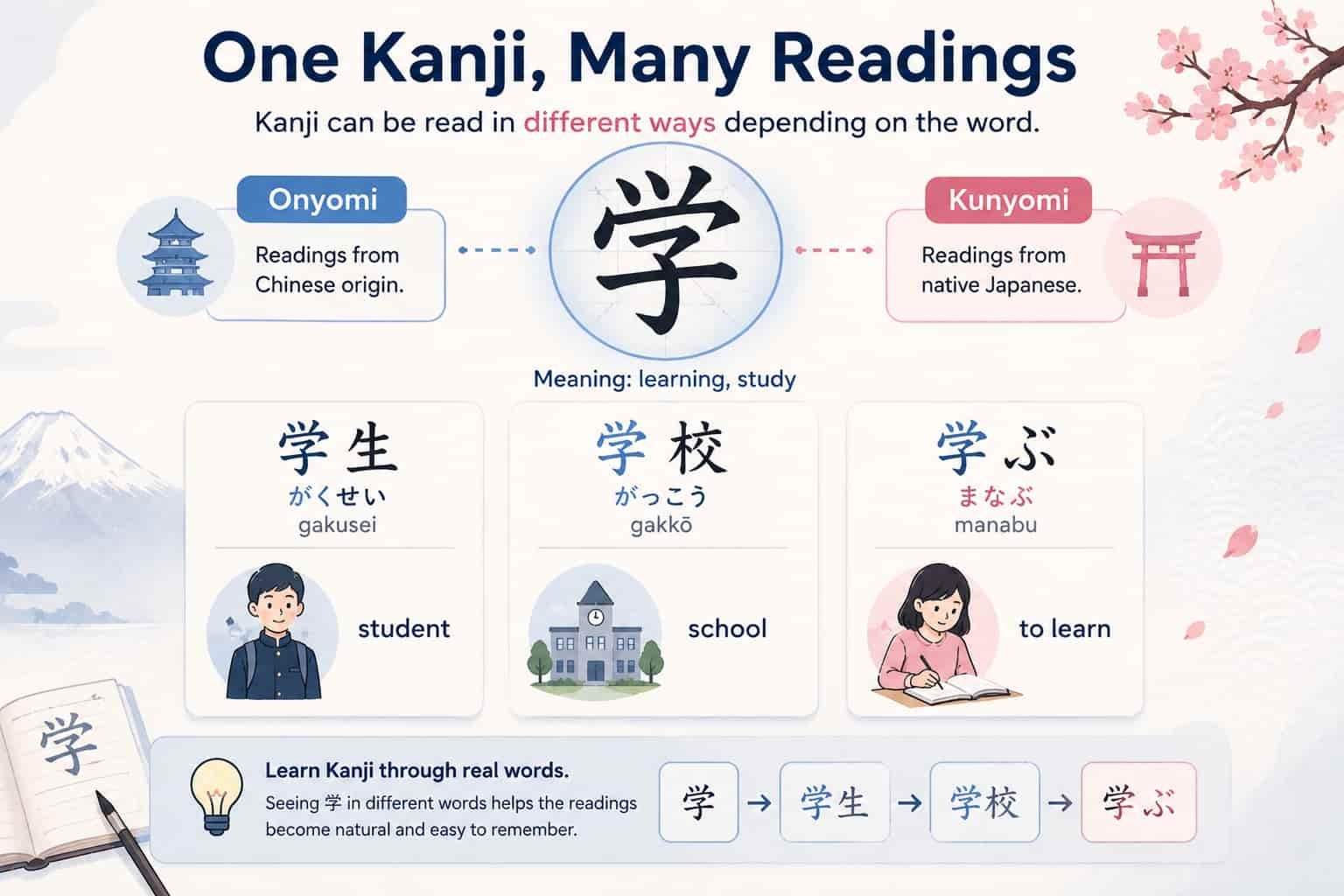
This happens because Japanese Kanji readings developed through different historical influences. You will often hear the terms Onyomi and Kunyomi.
For example, take the Kanji 学.
学
The character is connected with learning and study.
がくせい — student
がっこう — school
まなぶ — to learn
Instead of trying to memorize every reading separately, it can be much easier to learn the Kanji through actual vocabulary. When you repeatedly see 学 in 学生, 学校 and 学ぶ, the different readings begin to make more sense.
Kanji Can Actually Make Reading Faster
At the beginning, Kanji usually makes reading slower because you have to stop and remember what the character means.
After you become familiar with common Kanji, the situation changes.
You can start recognizing groups of characters almost immediately. A word such as 日本語 becomes something your brain recognizes as a whole instead of three completely unfamiliar symbols.
This is one reason experienced Japanese readers can move through Kanji-heavy text much more naturally than beginners.
The difficult part is getting through that early stage where everything looks unfamiliar.
Practise Kanji with Learn Kanji
How Can You Learn So Many Kanji Without Getting Overwhelmed?
The trick is not to treat Kanji as one giant task. Learn a small number, use them in words, review them and then move forward. A simple routine might look like this:
- Choose a manageable JLPT level.
- Learn a few new Kanji.
- Study their meanings and readings.
- Learn common vocabulary containing those Kanji.
- Practise writing the characters you find difficult.
- Test yourself instead of only rereading the information.
- Review difficult Kanji again after some time.
Regular practice matters much more than trying to memorize a huge number of characters in a single sitting.
How Learn Kanji Can Help
If you are looking for a practical way to organize this kind of study, Learn Kanji: JLPT N5–N1 is built around the idea of keeping your Kanji learning in one place.
You can start by choosing a JLPT level from N5 through N1 and then open individual Kanji to study their meanings, readings and vocabulary. The app also lets you keep track of which characters you are currently learning and which ones you have already learned.
That is useful because not every Kanji needs the same amount of attention. Some characters will be easy after seeing them a few times. Others will keep causing problems.
Practise More Than Just Looking at Kanji
Simply looking at a Kanji and thinking “I know this one” is not always enough.
You might recognize 駅 when you see it, but forget how to write it. You might remember the meaning of a character but forget its reading. Or you might confuse it with another character that looks similar.
This is where different types of practice become useful.
Learn Kanji includes an interactive writing canvas, so you can actually practise drawing characters instead of only looking at them. It also includes quizzes and games for more active revision.
Writing Practice
Practise drawing difficult Kanji with the interactive canvas.
Games
Use interactive games to make Kanji revision more active.
Quizzes
Test your memory with JLPT and individual-Kanji quizzes.
Keep the Kanji You Struggle With
Everyone has a few Kanji that simply refuse to stay in memory. Maybe you always forget one reading. Maybe two characters look almost identical. Maybe there is a Kanji you keep seeing but never quite remember. Instead of repeatedly searching for those characters, Learn Kanji lets you create your own study lists. You can also save favourites and personal notes. For example, you could create lists such as:
- Kanji I Always Forget
- N4 Review
- Similar Kanji
- JLPT Exam Practice
- Kanji to Practise This Week
This makes your study more personal. You are not just following a fixed list; you are building a revision system around the characters that actually give you trouble.
There Is No Need to Rush
One of the biggest mistakes beginners make with Kanji is trying to learn too many too quickly. You might memorize twenty characters today and forget half of them a few days later. That can feel discouraging, but it is completely normal. Kanji is a long-term part of Japanese learning. The more often you see a character in real words and sentences, the more familiar it becomes. Even learning five characters well is better than rushing through fifty and remembering almost none of them.
What Makes Learn Kanji App Useful for This?
The main reason to use a Kanji app is not simply to have another dictionary on your phone. It is to make regular practice easier.
Learn Kanji app combines several parts of the learning process: JLPT N5–N1 levels, Kanji meanings and readings, vocabulary, writing practice, quizzes, games, progress tracking, favourites, personal notes and custom study lists.
There is also a 3D viewer for supported Kanji, giving learners another way to look at the structure of a character.
You can start with a Kanji, study its information, practise it, test yourself and then save it for later review without constantly switching between different tools.

A Simple Kanji Learning Flow
- Choose your JLPT level.
- Open a Kanji.
- Learn its meaning and readings.
- Look at vocabulary and examples.
- Practise writing it.
- Take a quiz or play a game.
- Add difficult Kanji to your own list.
- Mark it as Learned when you feel confident.
So, Is Japanese Really That Complicated?
Japanese writing definitely has a learning curve. Kanji has a long history, characters can have different readings, and there are a lot of them to learn. There is no point pretending otherwise. But the system starts making more sense once you understand why it exists. Kanji helps communicate meaning. Hiragana handles much of the grammar and native Japanese writing. Katakana handles many foreign words and other special uses. Together, they form the writing system you see in everyday Japanese. And you do not have to master everything at once. Start with a small group of common characters. Learn them through real words. Write them. Read them. Test yourself. Then move on to the next group.
Final Thoughts
So, why does Japanese have so many Kanji?
It is largely the result of the long history of Japanese writing and the adoption and adaptation of Chinese characters. Over hundreds of years, Japanese developed a writing system where Kanji, Hiragana and Katakana each play an important role.
For a beginner, the number of Kanji can look frightening. But you do not need to think about all of them at once.
Think about the next five. Then the next five.
With regular practice, characters that once looked completely unfamiliar slowly become words you recognize without thinking about them.
If you want a structured place to practise along the way, Learn Kanji: JLPT N5–N1 is available free on Google Play with JLPT-level study, writing practice, quizzes, games, custom study lists and progress tracking.
Get Learn Kanji on Google Play