聞 – JLPT N5 Kanji, Kanji for ask, hear, listen (With 3D Visualization)
Kanji for ask, hear, listen
Fast lookup with examples and clean stroke-order visualization.
Experience 聞 in 3D! View the complete 3D Kanji model to understand its shape and stroke depth from every angle. Click the button below to see 聞 in 3D and explore how each stroke forms this character.
Please support us by sharing!
Discover Related Kanji
Find visually similar kanji, commonly confused characters, related meanings, and useful words connected to 聞.
聞
- Meanings
- ask, hear, listen
- Onyomi
- ブン , モン
- Kunyomi
- き.く , き.こえる
- Name Readings
- JLPT
- N5
- Grade
- 2
- Frequency
- -
- Kanji Writing Practice
- Practice
Stroke Order
Story
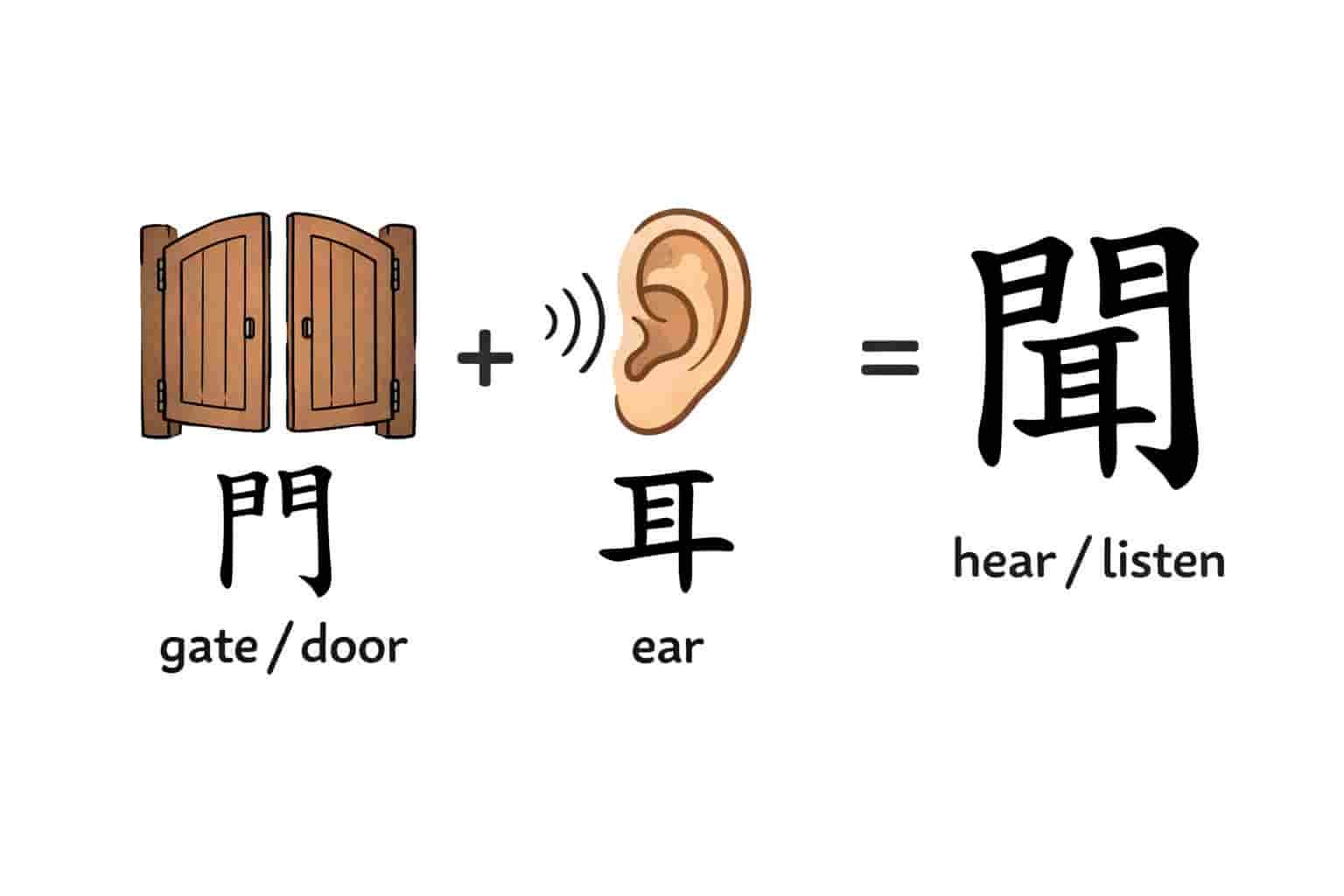
The kanji 聞 combines the elements 耳 (ear) and 門 (gate or door). In ancient times, sound was imagined as something that traveled through space, reaching the ears of those nearby. The gate (門) represents an opening — a doorway through which voices, music, and messages can enter. Together, they form the idea of “hearing through an opening,” or the act of listening attentively to what comes from beyond. This became the kanji for “to hear” or “to listen.”
Short Story
Made from 耳 (ear) inside 門 (gate), this kanji shows the image of an ear listening through a door — the essence of hearing and paying attention to sounds or words that come from outside.
Mnemonic
This kanji declares: the ear (耳) listens through the gate (門). It represents opening yourself to the world — hearing, understanding, and letting sound and knowledge enter. 聞 means to truly listen.
Vocabulary Examples
| Word | Reading | Meaning | Meta |
|---|---|---|---|
| 聞く | きく | to hear | common JLPT-N5 Godan verb with 'ku' ending, Transitive verb |
| 聞こえる | きこえる | to be heard, to be audible, to reach one's ears | common JLPT-N4 Ichidan verb, Intransitive verb |
| 聞かす | きかす | to let (someone) hear, to tell (e.g. a story), to inform (of) | common Godan verb with 'su' ending, Transitive verb |
| 聞き取る | ききとる | to catch (someone's words), to make out, to follow, to understand | Godan verb with 'ru' ending, Transitive verb |
| 聞き入る | ききいる | to listen attentively to, to be absorbed in (listening to) | Godan verb with 'ru' ending, Intransitive verb |
| 聞き出す | ききだす | to get (information) out of someone, to extract (information) from someone, to find out (through questioning) | Godan verb with 'su' ending, Transitive verb |
| 聞き上手 | ききじょうず | being a good listener, good listener | Noun, Na-adjective (keiyodoshi) |
| 聞き取り | ききとり | listening comprehension, aural comprehension | common JLPT-N1 Noun |
| 聞き入れる | ききいれる | to grant (a wish), to accede, to comply with, to heed | Ichidan verb, Transitive verb |
| 聞き飽きる | ききあきる | to be tired of hearing | Ichidan verb, Transitive verb |
| 聞き漏らす | ききもらす | to fail to hear, to miss | Godan verb with 'su' ending, Transitive verb |
| 聞く耳を持たない | きくみみをもたない | to turn a deaf ear to, to not listen to, to not get the message | Expressions (phrases, clauses, etc.), I-adjective (keiyoushi) |
| 聞かせる | きかせる | to let (someone) hear, to tell (e.g. a story), to inform (of) | Ichidan verb, Transitive verb |
| 聞きたがる | ききたがる | to be curious, to be inquisitive, to want to hear | Godan verb with 'ru' ending |
| 聞き覚え | ききおぼえ | learning by ear | Noun |