話 – JLPT N5 Kanji, Kanji for tale, talk (With 3D Visualization)
Kanji for tale, talk
Fast lookup with examples and clean stroke-order visualization.
Experience 話 in 3D! View the complete 3D Kanji model to understand its shape and stroke depth from every angle. Click the button below to see 話 in 3D and explore how each stroke forms this character.
Please support us by sharing!
Discover Related Kanji
Find visually similar kanji, commonly confused characters, related meanings, and useful words connected to 話.
話
- Meanings
- tale, talk
- Onyomi
- ワ
- Kunyomi
- はな.す , はなし
- Name Readings
- JLPT
- N5
- Grade
- 2
- Frequency
- -
- Kanji Writing Practice
- Practice
Stroke Order
Story
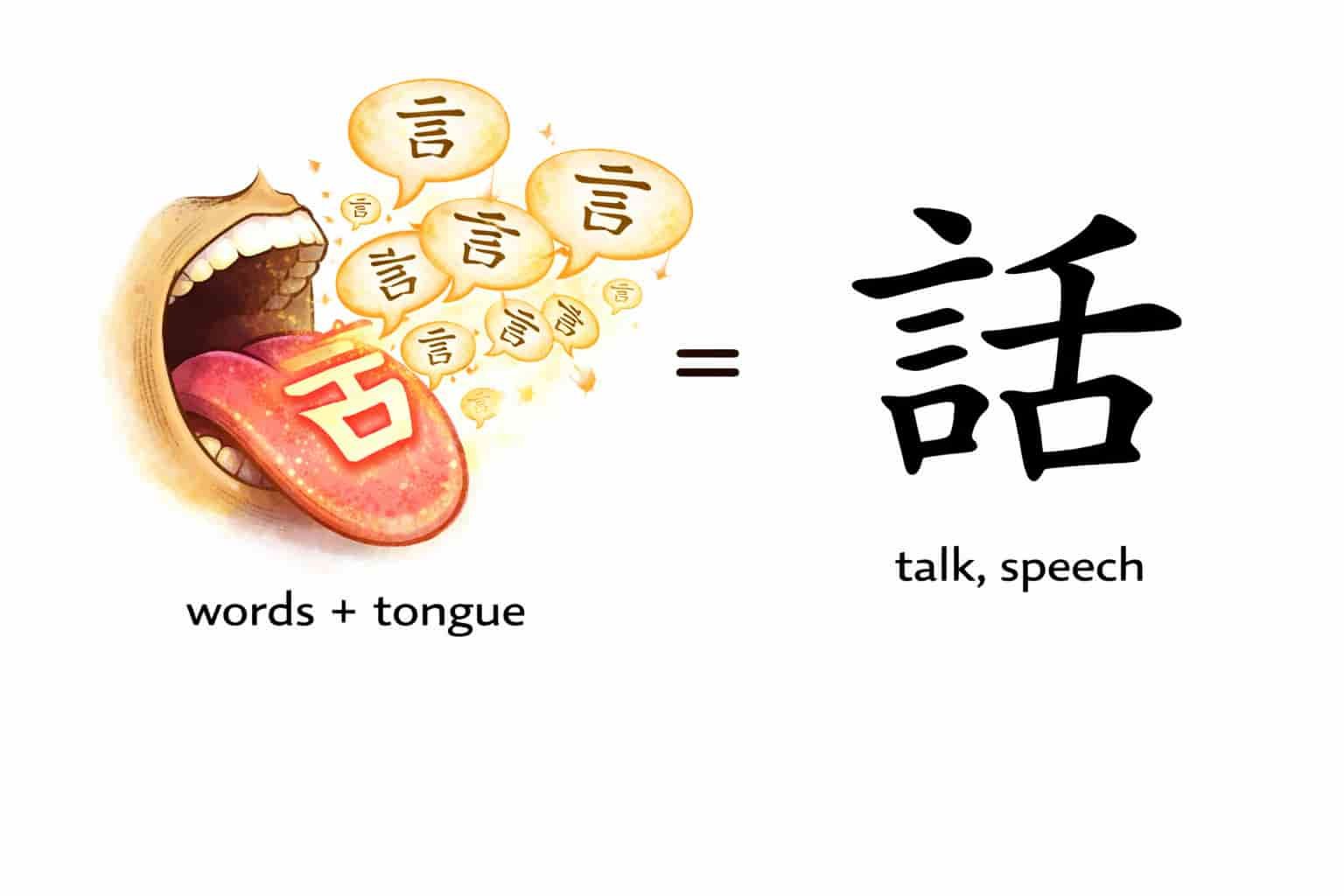
The kanji 話 is made from two parts: 言 (words, speech) on the left and 舌 (tongue) on the right. Together, they create a clear image — words shaped by the tongue. In ancient writing, this symbol expressed the act of speaking or conversing, when thoughts turn into sounds that reach another person. It reminds us that talking is how we connect, share, and make understanding possible.
Short Story
A combination of 言 (words) and 舌 (tongue), 話 shows the act of using your tongue to form words — to speak or talk.
Mnemonic
Picture your tongue (舌) moving as you form words (言) that flow out into the air — that’s 話, the kanji for speaking and conversation. Imagine yourself telling a story to a friend — your tongue shapes the words that connect your hearts.
Vocabulary Examples
| Word | Reading | Meaning | Meta |
|---|---|---|---|
| 話 | はなし | talk, speech, chat, conversation | common JLPT-N5 Noun |
| 話 | わ | counter for stories, episodes of TV series, etc. | Counter |
| 話題 | わだい | topic, subject | common JLPT-N3 Noun |
| 話す | はなす | to talk, to speak, to converse, to chat | common JLPT-N5 Godan verb with 'su' ending, Transitive verb |
| 話し合う | はなしあう | to discuss, to talk together | common JLPT-N3 Godan verb with 'u' ending, Transitive verb |
| 話し合い | はなしあい | discussion, talk, tête-à-tête, conference | common JLPT-N2 JLPT-N1 Noun, Suru verb |
| 話しかける | はなしかける | to address (someone), to accost a person, to talk (to someone) | common JLPT-N2 Ichidan verb, Transitive verb |
| 話し中 | はなしちゅう | busy (phone) | JLPT-N2 Noun which may take the genitive case particle 'no' |
| 話し言葉 | はなしことば | spoken language, colloquial expression | common Noun |
| 話し声 | はなしごえ | speaking voice, talking voice | common Noun |