川 – JLPT N5 Kanji, Kanji for river, river or three-stroke river radical no 47, stream (With 3D Visualization)
Kanji for river, river or three-stroke river radical no 47, stream
Fast lookup with examples and clean stroke-order visualization.
Experience 川 in 3D! View the complete 3D Kanji model to understand its shape and stroke depth from every angle. Click the button below to see 川 in 3D and explore how each stroke forms this character.
Please support us by sharing!
Discover Related Kanji
Find visually similar kanji, commonly confused characters, related meanings, and useful words connected to 川.
川
- Meanings
- river, river or three-stroke river radical (no. 47), stream
- Onyomi
- セン
- Kunyomi
- かわ
- Name Readings
- か, こ, さわ
- JLPT
- N5
- Grade
- 1
- Frequency
- -
- Kanji Writing Practice
- Practice
Stroke Order
Story
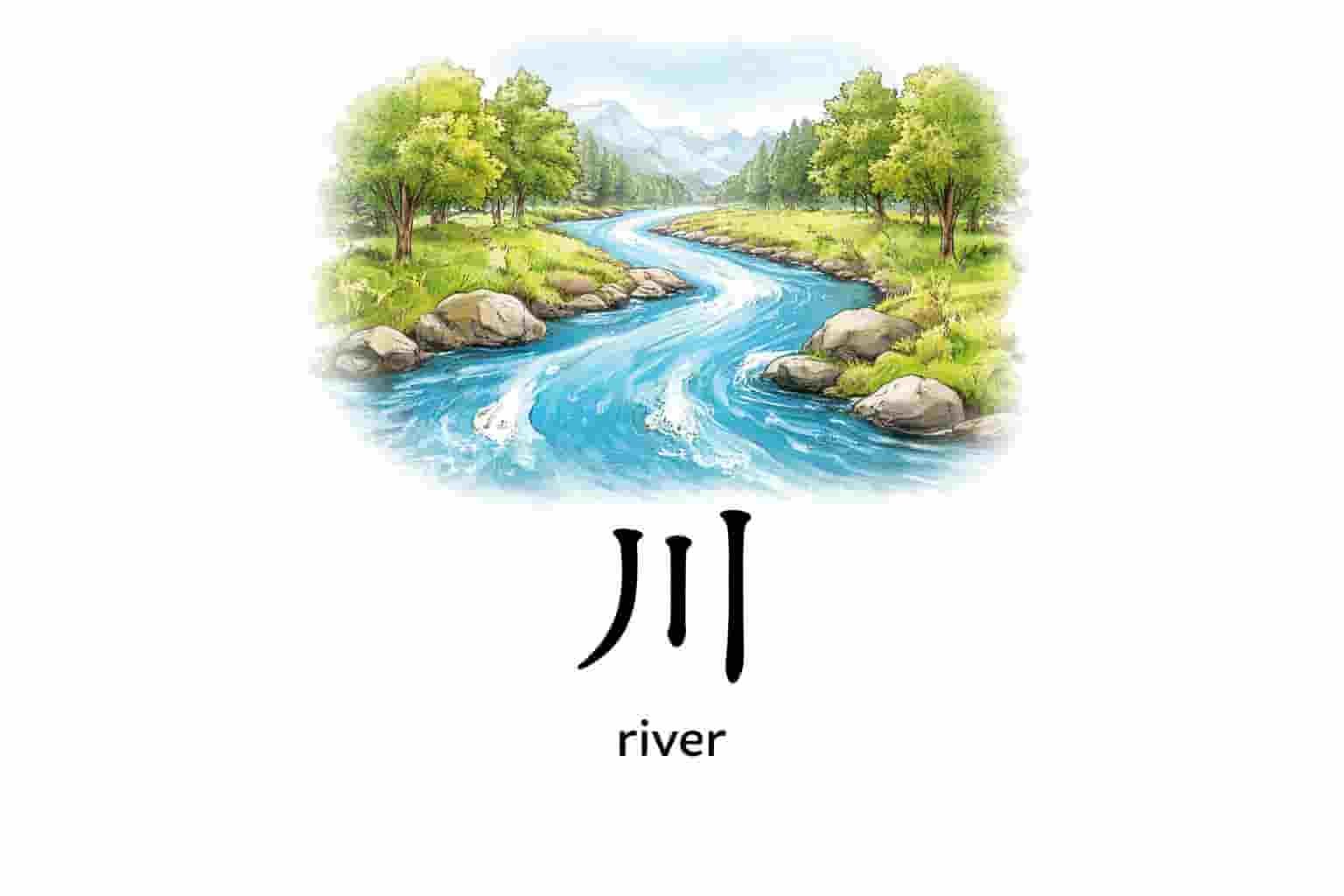
The kanji 川 comes from a simple picture of flowing water. In ancient writing, it was drawn as three lines — the streams of a river moving side by side. People used this shape to show the idea of water flowing in one direction, carving its way through the land. Over time, the image stayed almost the same, becoming the modern kanji for “river.”
Short Story
Three lines flowing downward — this kanji shows the image of a river, water moving smoothly through nature. It’s one of the simplest and oldest symbols in Japanese writing.
Mnemonic
This kanji declares: three streams flow together as one — 川 means river, the steady flow of water through the world.
Vocabulary Examples
| Word | Reading | Meaning | Meta |
|---|---|---|---|
| 川 | かわ | river, stream | common JLPT-N3 JLPT-N5 Noun |
| 川沿い | かわぞい | along the river, riverside | common Noun which may take the genitive case particle 'no' |
| 川上 | かわかみ | upper reaches of a river, upstream | common Noun |
| 川岸 | かわぎし | riverbank, riverside | common Noun |
| 川幅 | かわはば | width of a river | Noun |
| 川風 | かわかぜ | breeze off a river | Noun |
| 川流れ | かわながれ | being carried away by a current | Noun |
| 川底 | かわぞこ | riverbed | Noun |
| 河口 | かこう | mouth of river, estuary | common Noun, Noun which may take the genitive case particle 'no' |
| 川下り | かわくだり | going downstream (in a boat) | Noun |