語 – JLPT N5 Kanji, Kanji for language, speech, word (With 3D Visualization)
Kanji for language, speech, word
Fast lookup with examples and clean stroke-order visualization.
Experience 語 in 3D! View the complete 3D Kanji model to understand its shape and stroke depth from every angle. Click the button below to see 語 in 3D and explore how each stroke forms this character.
Please support us by sharing!
Discover Related Kanji
Find visually similar kanji, commonly confused characters, related meanings, and useful words connected to 語.
語
- Meanings
- language, speech, word
- Onyomi
- ゴ
- Kunyomi
- かた.らう , かた.る
- Name Readings
- JLPT
- N5
- Grade
- 2
- Frequency
- -
- Kanji Writing Practice
- Practice
Stroke Order
Story
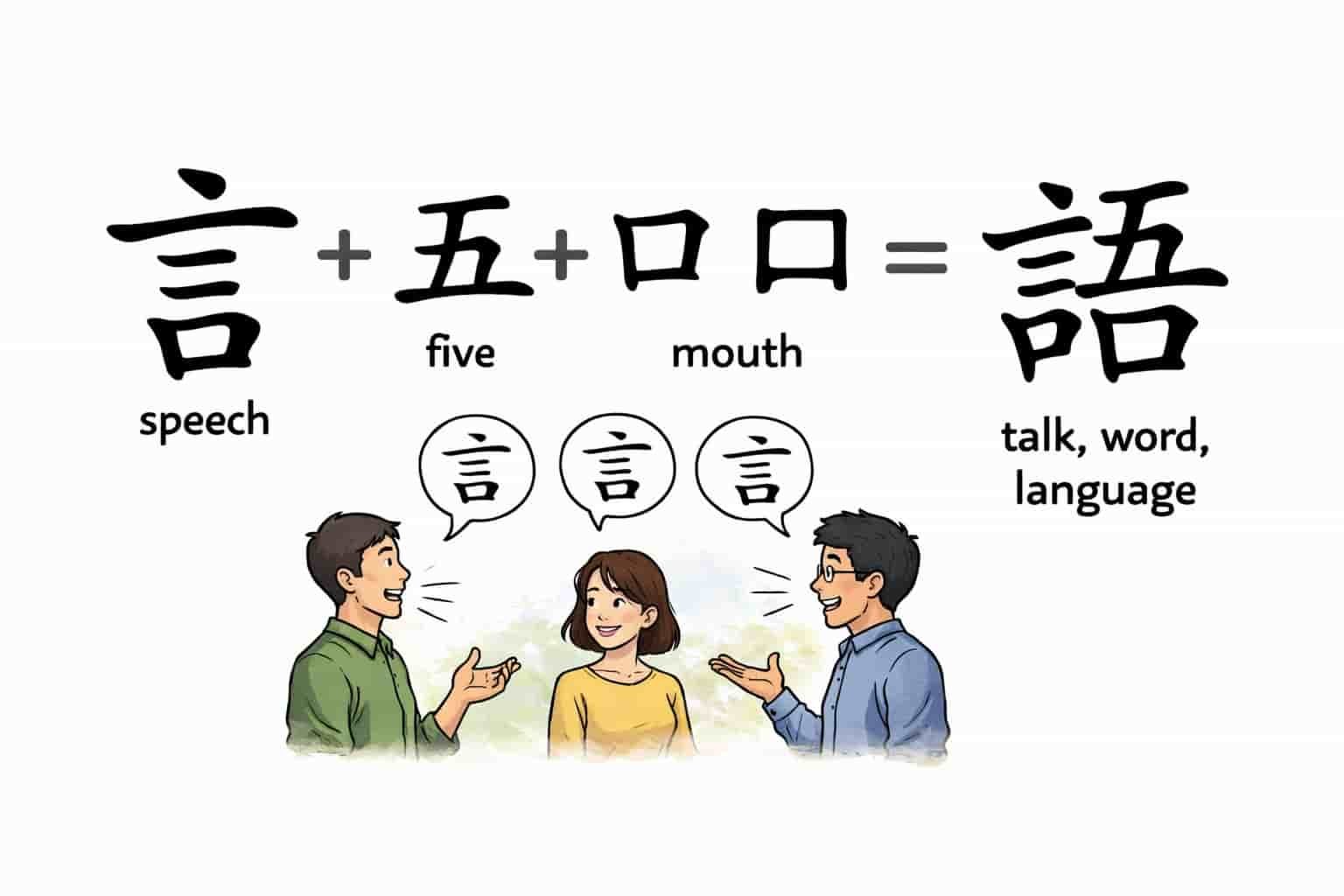
The kanji 語 combines 言 (speech or words) on the left with 五 (five) and 口 (mouth) on the right. In ancient writing, it suggested the idea of many mouths speaking — several people using words together. Words, when shared, form language and understanding. So 語 came to mean “to talk,” “word,” or “language,” expressing communication between people.
Short Story
語 joins 言 (speech) with elements meaning “many mouths.” It paints the picture of people talking and sharing words — the essence of language and communication.
Mnemonic
This kanji declares: words (言) come from many mouths (五 + 口) — 語 means language, the power of people speaking and understanding one another.
Vocabulary Examples
| Word | Reading | Meaning | Meta |
|---|---|---|---|
| 語 | ご | word, term | common JLPT-N3 Noun, Noun, used as a suffix, Counter |
| 語り | かたり | talk, recital | common Noun |
| 語源 | ごげん | origin of a word, derivation of a word, etymology | common JLPT-N1 Noun |
| 語彙 | ごい | vocabulary, lexicon, lexis, terminology | common JLPT-N1 Noun |
| 語る | かたる | to talk about, to speak of, to tell, to narrate | common JLPT-N3 Godan verb with 'ru' ending, Transitive verb |
| 語学 | ごがく | study of foreign languages | common JLPT-N3 Noun |
| 語句 | ごく | words and phrases, words | JLPT-N1 Noun |
| 語らう | かたらう | to talk, to tell, to recite, to pledge, to conspire with | common Godan verb with 'u' ending, Transitive verb |
| 語気 | ごき | tone, manner of speaking | common Noun |
| 語り口 | かたりくち | way of reciting, way of telling a story | common Noun |