誰 – JLPT N5 Kanji, Kanji for somebody, someone, who (With 3D Visualization)
Kanji for somebody, someone, who
Fast lookup with examples and clean stroke-order visualization.
Experience 誰 in 3D! View the complete 3D Kanji model to understand its shape and stroke depth from every angle. Click the button below to see 誰 in 3D and explore how each stroke forms this character.
Please support us by sharing!
Discover Related Kanji
Find visually similar kanji, commonly confused characters, related meanings, and useful words connected to 誰.
誰
- Meanings
- somebody, someone, who
- Onyomi
- スイ
- Kunyomi
- だれ
- Name Readings
- JLPT
- N5
- Grade
- 8
- Frequency
- -
- Kanji Writing Practice
- Practice
Stroke Order
Story
Long ago, this kanji was formed from the parts 言 (speech, words) and 隹 (a short-tailed bird). In ancient writing, birds often represented the sound of calling or voices carried through the air. So 誰 shows someone using speech like a bird’s call — sending their words out, searching for someone, asking “Who are you?” Over time, this image became the kanji for the question word “who.”
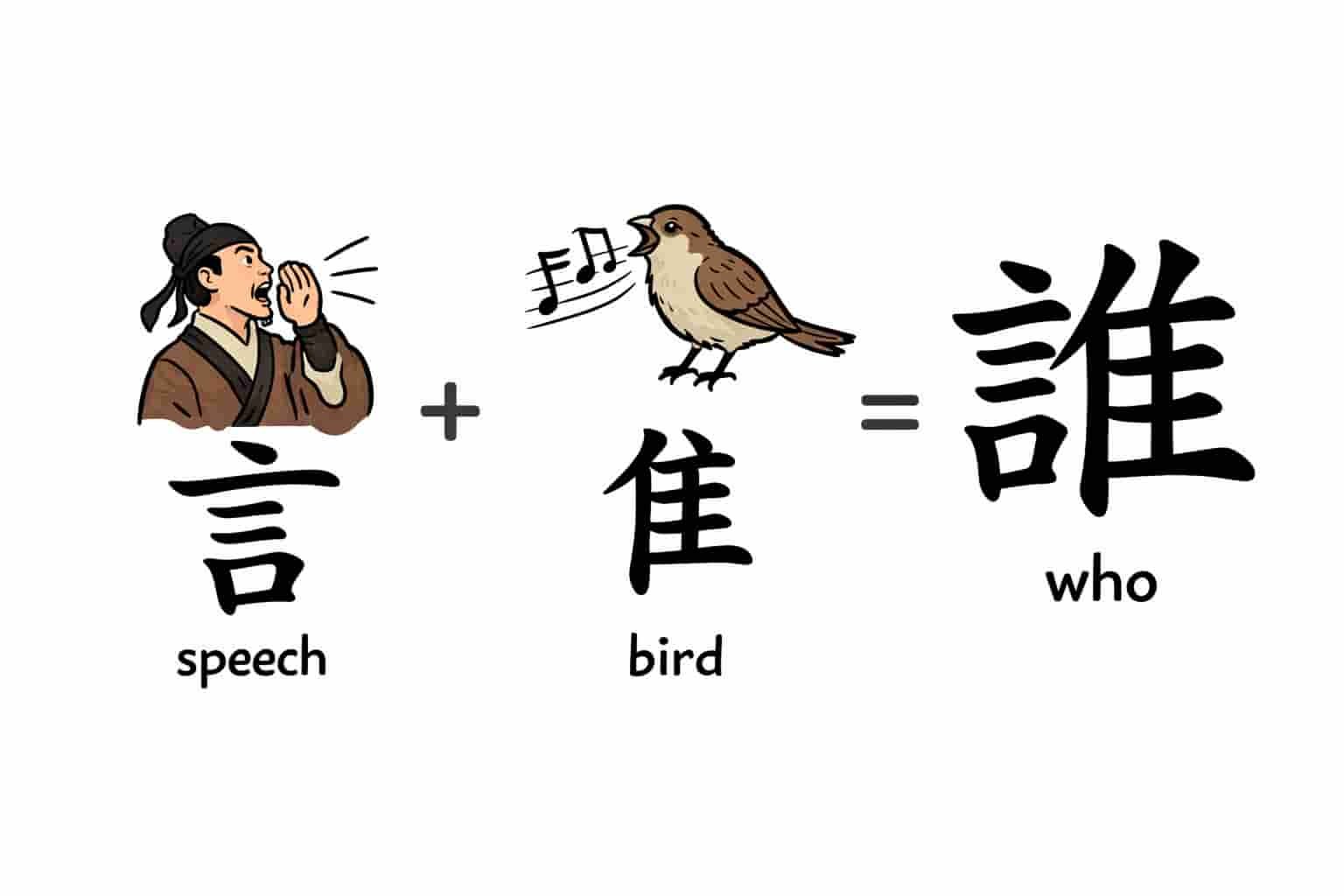
Short Story
誰 combines the idea of speech (言) with a calling bird (隹) — it represents a person’s voice reaching out to identify someone. It’s the feeling of calling out in the distance, asking, “Who’s there?”
Mnemonic
Imagine you’re calling someone far away — your words (言) fly like a little bird (隹) trying to find who will answer back. That’s 誰 — your voice searching for “who.”
Vocabulary Examples
| Word | Reading | Meaning | Meta |
|---|---|---|---|
| 誰 | だれ | who | common JLPT-N1 JLPT-N5 Pronoun |
| 誰か | だれか | someone, somebody | common JLPT-N3 JLPT-N5 Pronoun |
| 誰にも | だれにも | to anyone, to everyone | common Expressions (phrases, clauses, etc.) |
| 誰彼 | だれかれ | this or that person, anybody, many people | Pronoun |
| 誰しも | だれしも | everyone, anyone | Expressions (phrases, clauses, etc.) |
| 誰何 | すいか | challenging (an unknown person), asking a person's identity | Noun, Suru verb, Transitive verb |
| 誰もかも | だれもかも | everyone | Noun |
| 誰にも増して | だれにもまして | more than anybody | Expressions (phrases, clauses, etc.), Adverb (fukushi) |
| 誰一人 | だれひとり | (not) anyone, (not) a single person, no one, nobody | Expressions (phrases, clauses, etc.) |
| 誰も | だれも | everyone, anyone | common Expressions (phrases, clauses, etc.) |