高 – JLPT N5 Kanji, Kanji for expensive, high, tall (With 3D Visualization)
Kanji for expensive, high, tall
Fast lookup with examples and clean stroke-order visualization.
Experience 高 in 3D! View the complete 3D Kanji model to understand its shape and stroke depth from every angle. Click the button below to see 高 in 3D and explore how each stroke forms this character.
Please support us by sharing!
Discover Related Kanji
Find visually similar kanji, commonly confused characters, related meanings, and useful words connected to 高.
高
- Meanings
- expensive, high, tall
- Onyomi
- コウ
- Kunyomi
- たか , たか.い , たか.める
- Name Readings
- か, こ, じょい, た, はか
- JLPT
- N5
- Grade
- 2
- Frequency
- -
- Kanji Writing Practice
- Practice
Stroke Order
Story
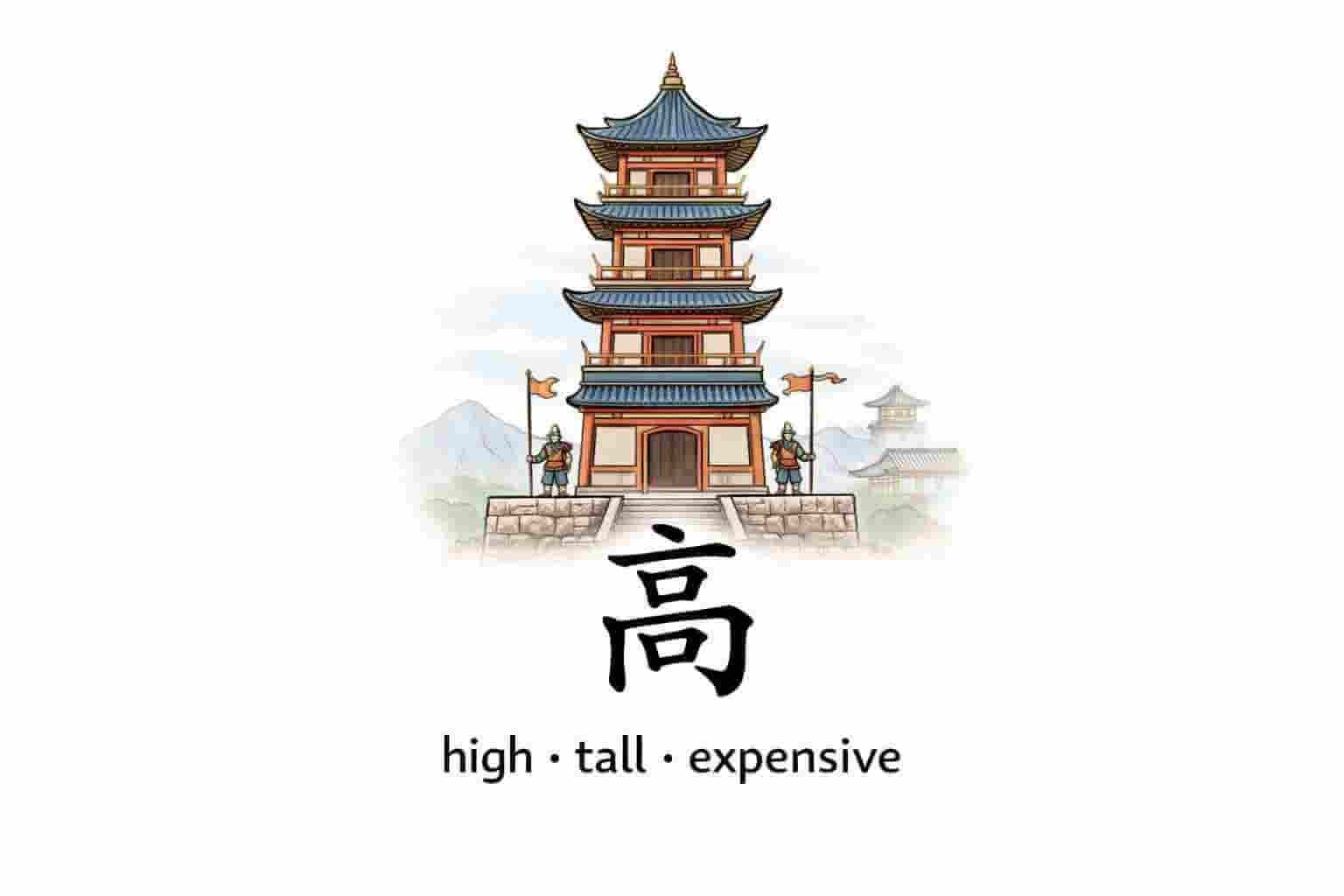
The kanji 高 was originally a pictograph of a tall building or tower with a roof and multiple layers. In ancient times, such high structures symbolized status, protection, and importance — places like watchtowers, temples, or grand halls. The top line represents the roof, the middle box shows the raised structure, and the base marks the foundation. Over centuries, this design came to mean anything “high” — in height, value, or status.
Short Story
Depicting a tall building with a roof and base, 高 represents height, elevation, and prominence — something raised above the ordinary, whether in structure, value, or position.
Mnemonic
This kanji declares: the tall roof stands above all — 高 means high, elevated, and important, a symbol of greatness rising above the rest.
Vocabulary Examples
| Word | Reading | Meaning | Meta |
|---|---|---|---|
| 高 | たか | quantity, amount, volume, number, amount of money | common JLPT-N1 Noun, Noun, used as a suffix |
| 高 | こう | high | Prefix, Noun |
| 高等学校 | こうとうがっこう | senior high school, high school | common JLPT-N4 Noun |
| 高い | たかい | high, tall | common JLPT-N5 I-adjective (keiyoushi) |
| 高校 | こうこう | senior high school, high school | common JLPT-N4 Noun |
| 高校生 | こうこうせい | senior high school student | common JLPT-N4 Noun |
| 高価 | こうか | highly priced, expensive, valuable, costly | common JLPT-N3 Na-adjective (keiyodoshi), Noun |
| 高速 | こうそく | high-speed, rapid, express | common JLPT-N3 Na-adjective (keiyodoshi), Noun which may take the genitive case particle 'no', Noun |
| 高度 | こうど | altitude, height, elevation | common JLPT-N2 Noun |
| 高める | たかめる | to raise, to lift, to boost, to enhance | common JLPT-N2 Ichidan verb, Transitive verb |