毎 – JLPT N5 Kanji, Kanji for every (With 3D Visualization)
Kanji for every
Fast lookup with examples and clean stroke-order visualization.
Experience 毎 in 3D! View the complete 3D Kanji model to understand its shape and stroke depth from every angle. Click the button below to see 毎 in 3D and explore how each stroke forms this character.
Please support us by sharing!
Discover Related Kanji
Find visually similar kanji, commonly confused characters, related meanings, and useful words connected to 毎.
毎
- Meanings
- every
- Onyomi
- マイ
- Kunyomi
- ごと
- Name Readings
- つね
- JLPT
- N5
- Grade
- 2
- Frequency
- -
- Kanji Writing Practice
- Practice
Stroke Order
Story
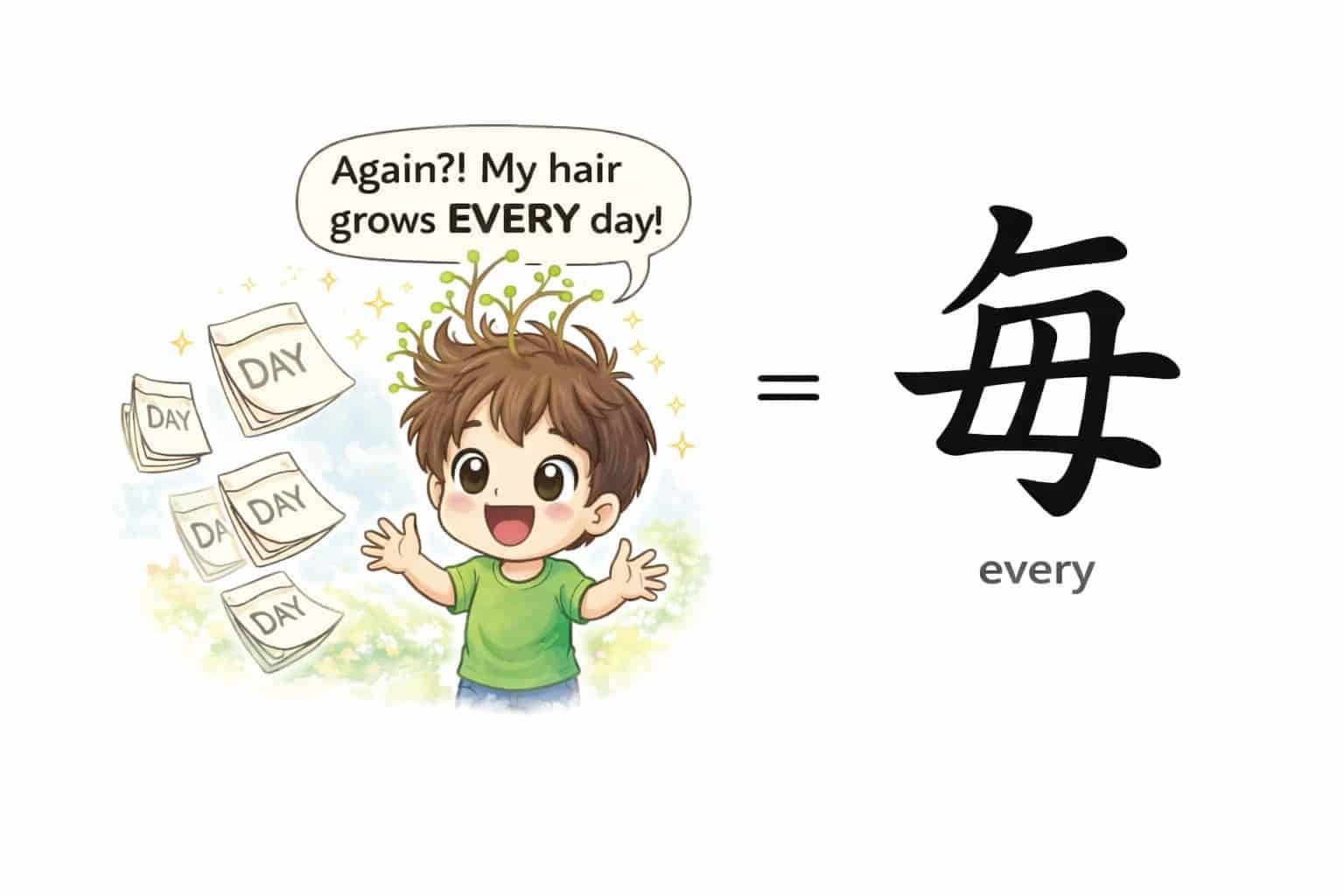
The kanji 毎 was originally a picture of hair or strands growing from a person’s head, symbolizing repetition and renewal. Over time, it came to represent the idea of something that happens again and again, just as hair continues to grow each day. In ancient writing, it included the element 毋, which means “do not,” but here it was used for its shape rather than meaning. Eventually, 毎 evolved to mean “every” — every day, every month, every occurrence that repeats with time.
Short Story
Derived from the image of hair growing again and again, 毎 expresses repetition — something that happens regularly or continuously, like each day or every time.
Mnemonic
This kanji declares: like hair that always grows back, 毎 represents what repeats — every day, every moment, everything that happens again and again.
Vocabulary Examples
| Word | Reading | Meaning | Meta |
|---|---|---|---|
| 毎 | まい | every (usu. with events, e.g. every weekend), each | common Prefix |
| 毎 | ごと | each, every | common JLPT-N1 Noun, Noun, used as a suffix, Adverb (fukushi) |
| 毎日 | まいにち | every day, daily | common JLPT-N5 Noun, Adverb (fukushi) |
| 毎朝 | まいあさ | every morning | common JLPT-N5 Noun, Adverb (fukushi) |
| 毎年 | まいとし | every year, yearly, annually | common JLPT-N5 Adverb (fukushi), Noun |
| 毎週 | まいしゅう | every week | common JLPT-N5 Noun, Adverb (fukushi) |
| 毎晩 | まいばん | every night | common JLPT-N5 Noun, Adverb (fukushi) |
| 毎度 | まいど | each time, always, often | common JLPT-N2 Noun, Adverb (fukushi) |
| 毎月 | まいつき | every month, each month, monthly | common JLPT-N5 Adverb (fukushi), Noun |
| 毎回 | まいかい | every time, each round | common Noun, Adverb (fukushi) |