前 – JLPT N5 Kanji, Kanji for before, in front (With 3D Visualization)
Kanji for before, in front
Fast lookup with examples and clean stroke-order visualization.
Experience 前 in 3D! View the complete 3D Kanji model to understand its shape and stroke depth from every angle. Click the button below to see 前 in 3D and explore how each stroke forms this character.
Please support us by sharing!
Discover Related Kanji
Find visually similar kanji, commonly confused characters, related meanings, and useful words connected to 前.
前
- Meanings
- before, in front
- Onyomi
- ゼン
- Kunyomi
- まえ
- Name Readings
- さき, さと, まい
- JLPT
- N5
- Grade
- 2
- Frequency
- -
- Kanji Writing Practice
- Practice
Stroke Order
Story
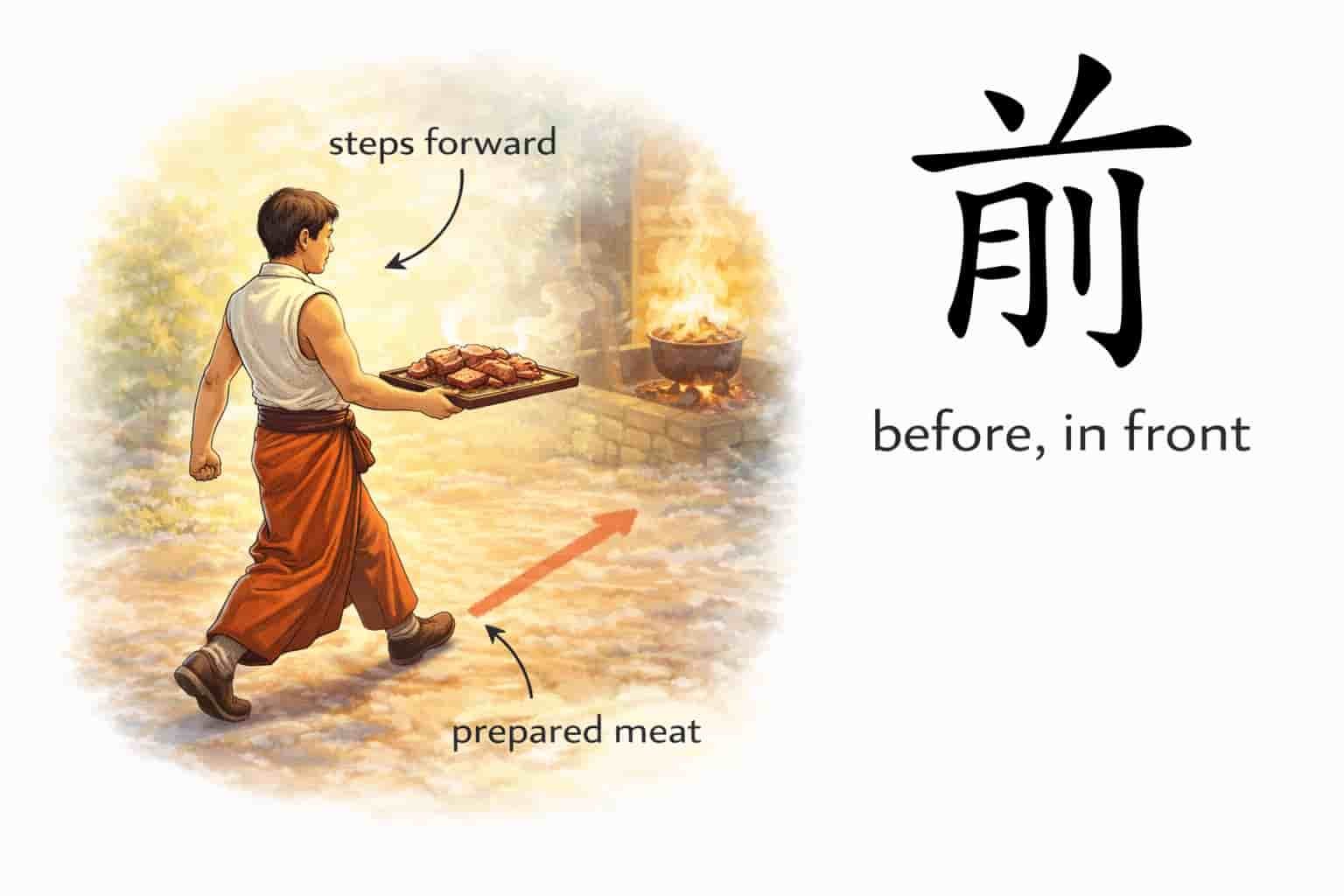
The kanji 前 combines two key parts: the radical for “movement” (止 – foot or step) at the bottom and a top part showing a slashed-off piece of meat (刈 or 月 in older forms). In ancient times, this showed a person stepping forward to prepare or present food — an act done “in front.” From this image, 前 came to mean “before” or “in front,” both in place and time. It reflects stepping ahead or something that comes earlier.
Short Story
A person stepping forward to present something — 前 means “in front” or “before,” the idea of moving ahead or being earlier.
Mnemonic
Picture yourself stepping forward (止) to offer something with both hands — you’re now in front, before everyone else. That’s 前, the kanji for “before” and “ahead.”
Vocabulary Examples
| Word | Reading | Meaning | Meta |
|---|---|---|---|
| 前 | ぜん | last (i.e. immediately preceding), previous, ex-, former | common JLPT-N1 Noun, used as a prefix |
| 先 | さき | point, tip, end, nozzle | common JLPT-N5 Noun |
| 前 | まえ | in front (of), before (e.g. a building) | common JLPT-N5 Noun |
| 前提 | ぜんてい | condition, assumption, prerequisite, hypothesis | common JLPT-N1 Noun |
| 前進 | ぜんしん | advance, moving forward, progress | common JLPT-N3 Noun, Suru verb, Intransitive verb |
| 前者 | ぜんしゃ | the former, the first | common JLPT-N3 Noun |
| 前後 | ぜんご | front and rear, front and back, before and behind, back and forth | common JLPT-N2 Noun |
| 前途 | ぜんと | future, prospects, outlook | common JLPT-N1 Noun |
| 前例 | ぜんれい | precedent | common JLPT-N1 Noun |
| 前売り | まえうり | advance sale, booking | common JLPT-N1 Noun, Suru verb, Transitive verb |