出 – JLPT N5 Kanji, Kanji for come out, exit, go out, leave, protrude (With 3D Visualization)
Kanji for come out, exit, go out, leave, protrude
Fast lookup with examples and clean stroke-order visualization.
Experience 出 in 3D! View the complete 3D Kanji model to understand its shape and stroke depth from every angle. Click the button below to see 出 in 3D and explore how each stroke forms this character.
Please support us by sharing!
Discover Related Kanji
Find visually similar kanji, commonly confused characters, related meanings, and useful words connected to 出.
出
- Meanings
- come out, exit, go out, leave, protrude, put out
- Onyomi
- シュツ
- Kunyomi
- だ.す , で.る
- Name Readings
- いず, いづ, いで, じ, すっ, すつ, てん
- JLPT
- N5
- Grade
- 1
- Frequency
- -
- Kanji Writing Practice
- Practice
Stroke Order
Story
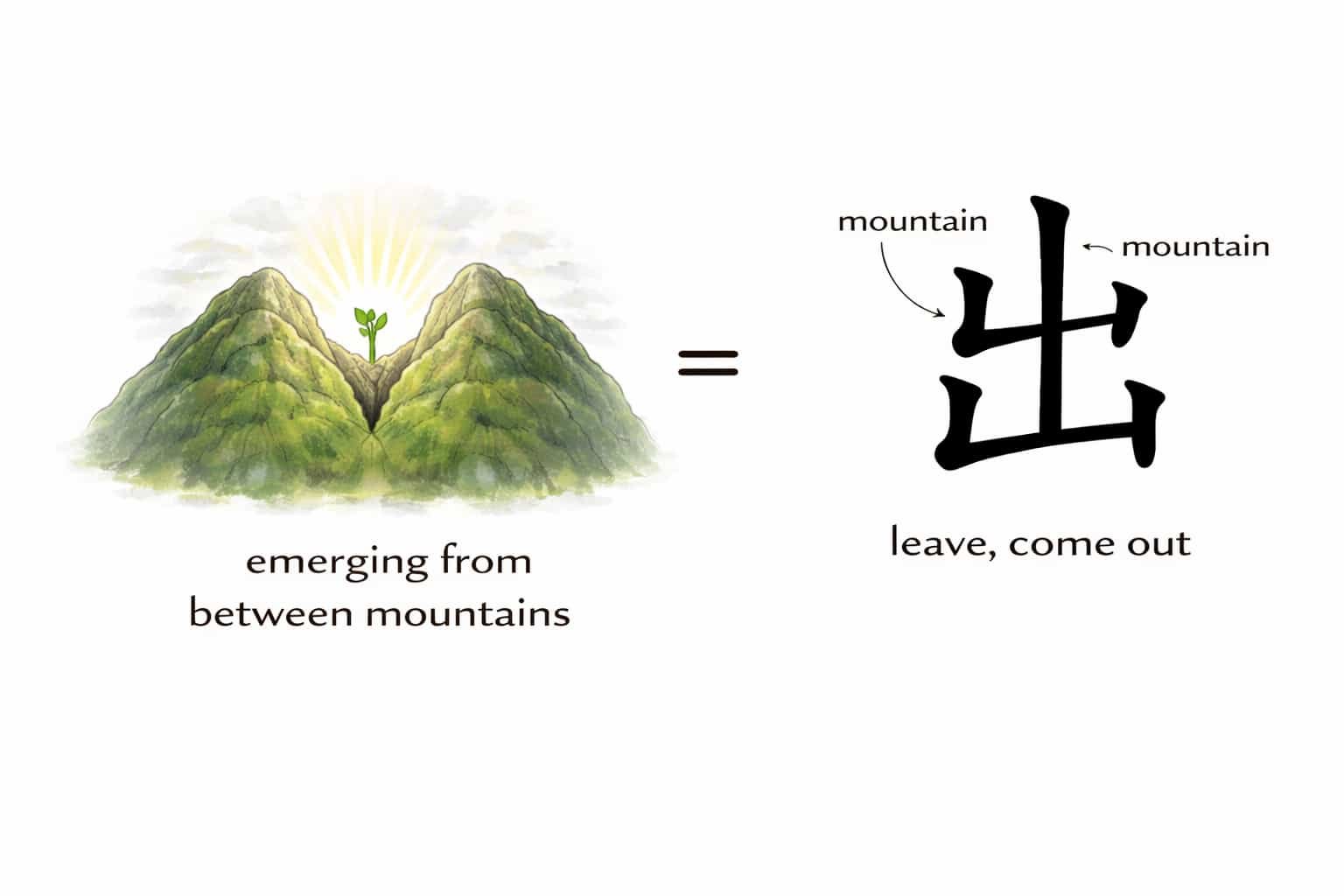
The kanji 出 was originally drawn as two mountains, one rising above the other. The idea is of something “coming out” or “emerging” — like a sprout pushing out of the ground or a person climbing out from between hills. From this image of “coming out from within,” the meaning became “to go out,” “to appear,” or “to bring out.”
Short Story
Two mountains, one above the other — 出 shows something rising or coming out, symbolizing “to go out” or “to appear.”
Mnemonic
Picture two mountains stacked together. From between them, something pushes upward — like a person or the sun coming out from behind the peaks. That’s 出, the kanji for “to go out” or “to come forth.”
Vocabulary Examples
| Word | Reading | Meaning | Meta |
|---|---|---|---|
| 出 | で | coming out, going out, outflow, efflux, rising (of the Sun or the Moon) | common Noun, Noun, used as a suffix |
| 出 | しゅつ | coming out, emerging | Noun |
| 出版 | しゅっぱん | publication | common JLPT-N3 Noun, Suru verb, Transitive verb |
| 出来る | できる | to be able to do, to be possible, to be permitted (to do) | common JLPT-N3 JLPT-N5 Ichidan verb, Intransitive verb |
| 出る | でる | to leave, to exit, to go out, to come out, to get out | common JLPT-N5 Ichidan verb, Intransitive verb |
| 出す | だす | to take out, to get out | common JLPT-N5 Godan verb with 'su' ending, Transitive verb |
| 出かける | でかける | to go out (e.g. on an excursion or outing), to leave, to depart, to start, to set out | common JLPT-N2 JLPT-N5 Ichidan verb, Intransitive verb |
| 出血 | しゅっけつ | bleeding, haemorrhage, hemorrhage | common JLPT-N1 Noun, Suru verb, Transitive verb, Intransitive verb |
| 出発 | しゅっぱつ | departure, leaving, setting off | common JLPT-N3 Noun, Suru verb, Intransitive verb |
| 出席 | しゅっせき | attendance, presence, appearance | common JLPT-N3 Noun, Suru verb, Intransitive verb |