見 – JLPT N5 Kanji, Kanji for chances, hopes, idea, look at, opinion (With 3D Visualization)
Kanji for chances, hopes, idea, look at, opinion
Fast lookup with examples and clean stroke-order visualization.
Experience 見 in 3D! View the complete 3D Kanji model to understand its shape and stroke depth from every angle. Click the button below to see 見 in 3D and explore how each stroke forms this character.
Please support us by sharing!
Discover Related Kanji
Find visually similar kanji, commonly confused characters, related meanings, and useful words connected to 見.
見
- Meanings
- chances, hopes, idea, look at, opinion, see, visible
- Onyomi
- ケン
- Kunyomi
- み.える , み.せる , み.る
- Name Readings
- JLPT
- N5
- Grade
- 1
- Frequency
- -
- Kanji Writing Practice
- Practice
Stroke Order
Story
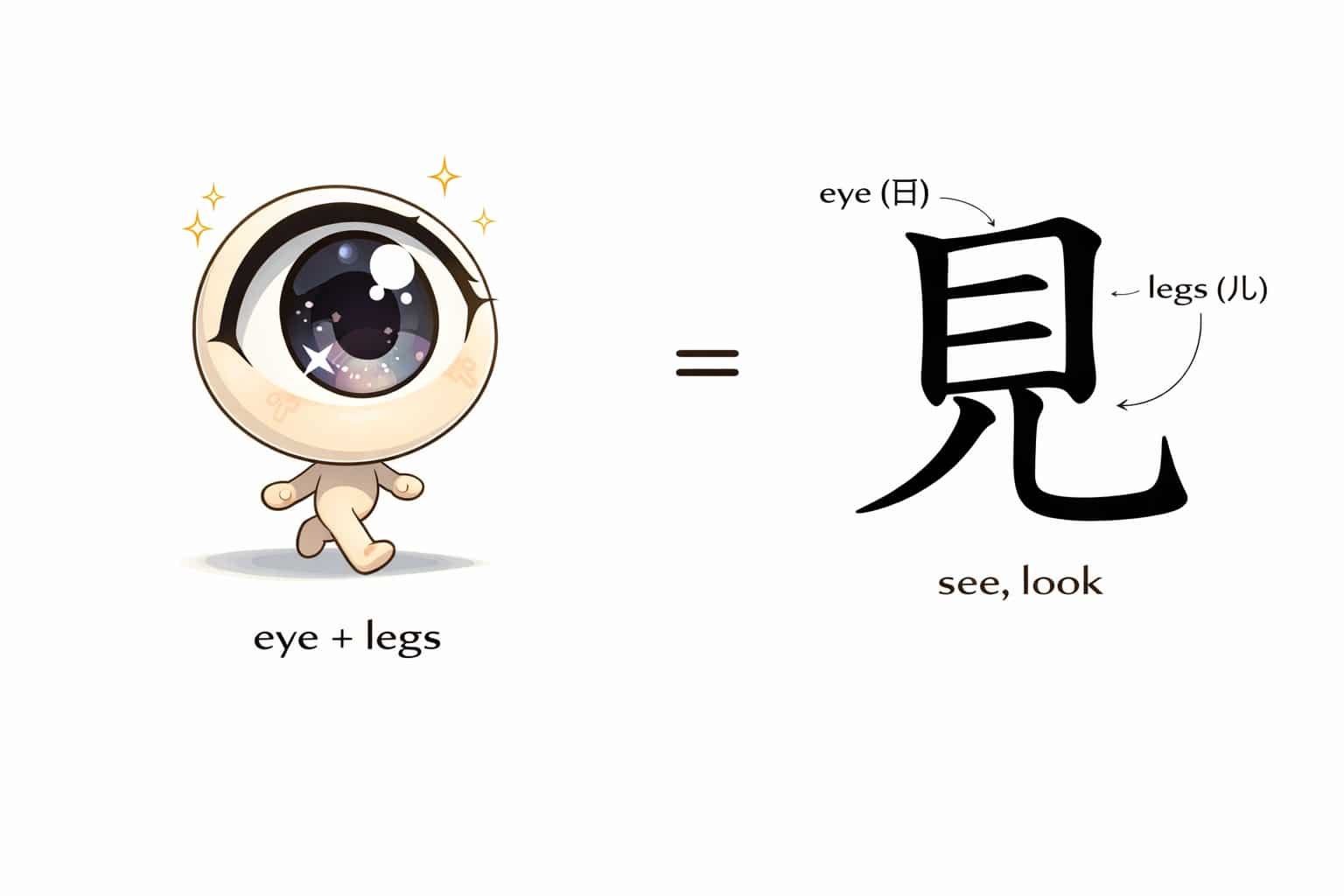
The kanji 見 is made of two parts: 目 (eye) on the top and 儿 (a person’s legs) on the bottom. Together, they form the picture of an eye on a person — someone using their eyes to look or observe. In ancient times, it literally showed “a person seeing with their eyes,” which became the idea of “to see,” “to look,” or “to watch.”
Short Story
An eye (目) on a person (儿) — 見 shows someone looking or observing with their eyes, meaning “to see.”
Mnemonic
Picture a person standing with a big eye on their face, looking around carefully at the world. That’s 見 — the act of seeing, watching, or observing with attention.
Vocabulary Examples
| Word | Reading | Meaning | Meta |
|---|---|---|---|
| 見 | み | looking, viewing | Noun, used as a suffix, Noun |
| 見 | けん | view (of life, etc.), outlook | Noun |
| 現在 | げんざい | the present, present time, now | common JLPT-N3 Noun, Adverb (fukushi), Noun which may take the genitive case particle 'no' |
| 見る | みる | to see, to look, to watch, to view, to observe | common JLPT-N5 Ichidan verb, Transitive verb |
| 店 | みせ | store, shop, establishment, restaurant | common JLPT-N5 Noun |
| 見せる | みせる | to show, to display | common JLPT-N5 Ichidan verb, Transitive verb |
| 見物 | けんぶつ | sightseeing, watching, viewing | common JLPT-N4 Noun, Suru verb, Transitive verb |
| 見合い | みあい | (formal) meeting with a view to marriage, interview with a prospective spouse | common JLPT-N1 Noun, Suru verb, Intransitive verb |
| 見える | みえる | to be seen, to be visible, to be in sight | common JLPT-N4 Ichidan verb, Intransitive verb |
| 見つかる | みつかる | to be found, to be discovered | common JLPT-N4 JLPT-N2 Godan verb with 'ru' ending, Intransitive verb |